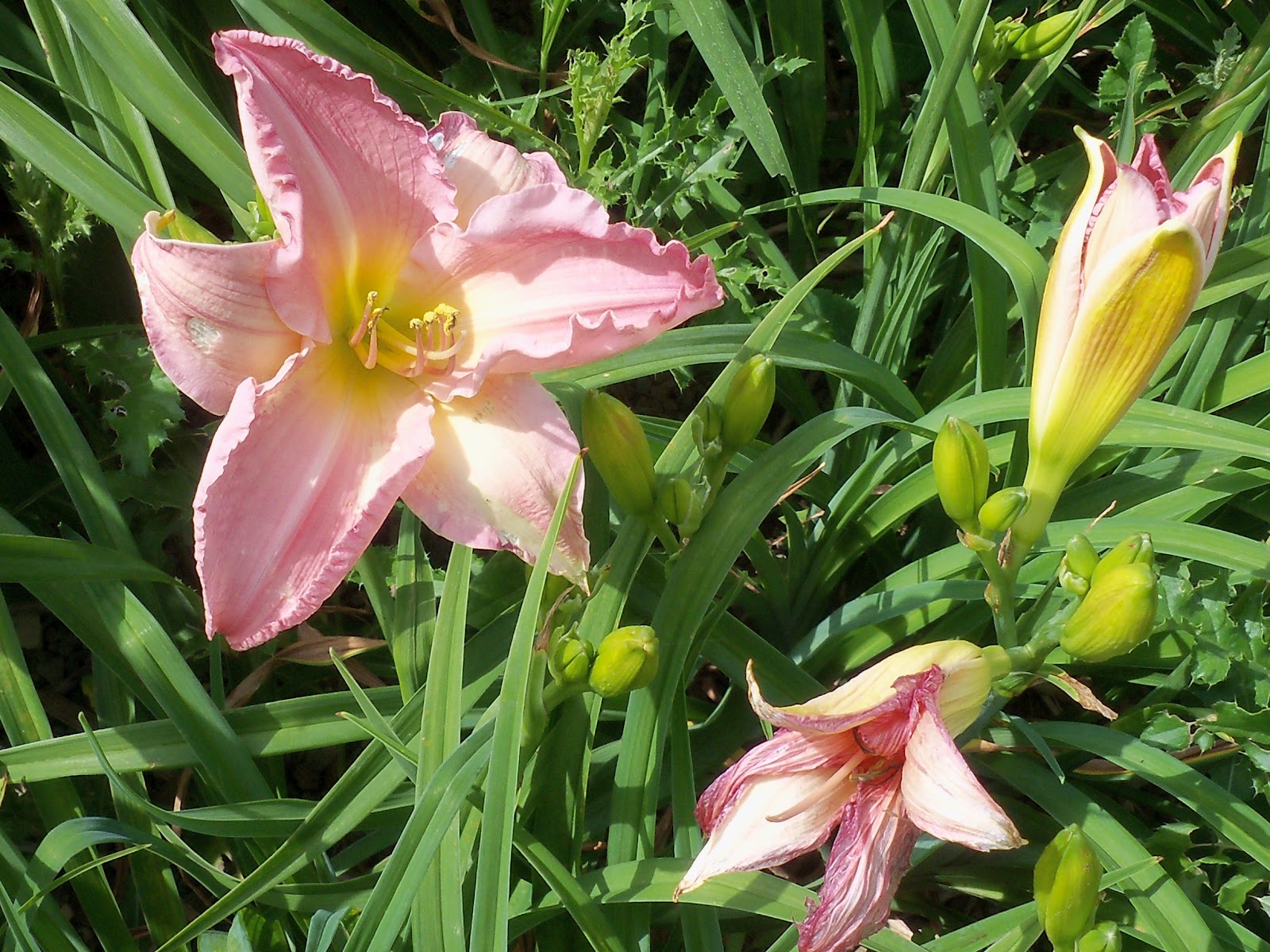
Showing posts with label daylily. Show all posts

Thursday, January 3, 2013

Yuletide Plantings, Part 1

The ‘Yuletide’ Camellias outside my office are brimming with buds, and I’m anxiously awaiting the initial bloom.  It’s not unlike receiving that first present at Christmas.  Sometimes the anticipation is just as great as the gift.
Monrovia grows 'Yuletide' for nurseries around the country.
Check with them for retailers in your neck of the woods.
And to be honest, these flowers are no sure thing.  Frigid overnight temperatures and a few days of ice and sleet could reduce each bud to tawny mush.  So I wait… in apprehensive hope.

Camellia sasanqua ‘Yuletide’ is my favorite camellia.  When in flower, its Christmas-red petals, surrounding a fat cluster of bright yellow stamens, remind me of Paeonia ‘Blaze’ or even the more exotic ‘Sword Dance’.
'Blaze' from Sandy's Plants in Mechanicsville, Virginia
 
'Sword Dance' from Viette Nurseries in Fishersville, Virginia
They are identifiably Japanese and yet seem right at home in Virginia’s urban gardens.  Their happy blooms are especially precious this time of year, set against an abundance of glossy, forest green leaves, miraculously delicate and tenacious, just at the start of real winter.
Camellia by Water, in style of Ogata Kenzan
hanging scroll, ink and color on paper, c.1741
from the H. O. Havemeyer Collection at the Metropolitan Museum of Art
We live at the western edge of the Piedmont, and Camellia’s range, and so there’s always a great deal of discussion about which is hardier: sasanqua or japonica.  I’ve heard votes for both.  Camellia sasanqua can handle a little more sun than japonica and tends to be more upright and slender.
The descriptors sasanqua and japonica can be confusing.
Camellia sasanqua originates from a small region in Japan,
while varieties of japonica grow naturally in many parts of Asia.
‘Yuletide’ is particularly charming for its tidy, slightly pyramidal shape.  Some folks trim it into standard tree form and prune the bottom branches.  But the three examples at work have been allowed to grow naturally.  Now, decades old, they are almost 10’ tall but only half as round.  Quite spectacular, really.  And they got me thinking about other plants that could extend the Christmas season throughout the year.

‘Yuletide’ is petite enough for even the smallest garden and would do well in a sheltered spot either as foundation planting or in a small grove of other shade-loving ornamentals.  Too much sun and wind are its greatest enemies.  Use its rich ever-greenery as a backdrop.  Underplant with Muscari armeniacum ‘Christmas Pearl’, Muscari ‘Peppermint’
Check with Brent and Becky's Bulbs for a fresh batch of 'Peppermint' next fall.
and Liriope muscari ‘Christmas Tree’ for a blanket of strappy foliage and pale purple blooms at the very beginning and end of the growing year.
Several years ago, I noticed quaint Liriope 'Christmas Tree'
along the Woodland Walk at Lewis Ginter Botanical Garden.
It can be difficult to find, even online and in garden catalogs.
Sandy's Plants supplies nurseries throughout the Mid-Atlantic...
or you can just buy directly from her.
Add some mossy pots of Caladium for a bit of iciness in the middle of summer.  ‘White Christmas’,
‘Peppermint’
and ‘Cranberry Star’
Classic Caladiums, in Central Florida, is a wholesale grower and breeder of Caladium.
They supply garden centers and florists around the country, but you can buy directly from them.
Just know that they usually require a minimum purchase of 10-25 bulbs.
capture the colors of ribbon candy.

Clear white and true red are difficult to breed in Daylilies; but there really isn’t a more cheerful color combination.  Can you imagine Hemerocallis ‘Christmas Wishes’ along a white picket fence?
'Christmas Wishes' from Oakes Daylilies in eastern Tennessee
Plant a swath of ‘Christmas Carol’,
'Christmas Carol' from Bluestone Perennials
‘Arctic Snow’
'Arctic Snow' from Roycroft Daylily Nursery where they only grow Daylilies...
just south of Georgetown, South Carolina
and ‘Carolina Cranberry’
'Carolina Cranberry' is also grown at Oakes.
Oakes, Roycroft and Viette's are all multi-generational, family-run businesses.
in front of Muhlenbergia capillaris ‘White Cloud’.
'White Cloud', at the United States Botanic Garden, was still a showstopper in mid-December. 
Interplant the Daylilies with Tulipa ‘Peppermint Stick’.
From Brent and Becky's Bulbs, near the Chesapeake Bay in Virginia
They all enjoy lots of sun and can handle a little drought.  Plus new growth on the Daylilies will hide Tulip foliage as it dies back.  Don’t worry… it is more subtle than it sounds.  Each species would have its moment, and if planted here in Virginia, the border would provide interest from April until December.

Hosta x ‘Christmas Tree’ and little ‘Ice Follies’ look like they have been edged in frosting.
'Christmas Tree' from Sandy's Plants
 
'Ice Follies' from Plant Delights
While each leaf of ‘Night Before Christmas’ and its sport ‘Christmas Candy’ seems filled with cream cheese or lemon custard.
'Night Before Christmas' from Sandy's Plants
 
'Christmas Candy' from Plant Delights
But Hosta ‘Stargazer’, a new introduction from Plant Delights in Raleigh, North Carolina, is perhaps the prettiest.
What a cool, sugary respite for your summer shade garden.

Varieties of Heuchera have been inspired by so many Christmas flavors, including the almost-indestructible Heuchera x brizoides ‘Plum Pudding’,
Check out Bluestone Perennials, based near the southern shore of Lake Erie, for a good selection of Heuchera.
marbled x americana ‘Peppermint Spice’,
From Sandy's Plants
villosa ‘Caramel’ with hints of peach and bronze and green,
You can order 'Caramel' for spring planting from White Flower Farm.
deeply-lobed ‘Chocolate Ruffles’,
and unusual ‘Mocha’ and ‘Ginger Ale’.
'Mocha' actually emerges in copper and then darkens to almost black.
The Missouri Botanical Garden has a lovely display of Heuchera, including 'Chocolate Ruffles' and 'Mocha'.
But Heuchera sanguinea ‘Snow Angel’ is my absolute favorite for its frilly leaves, speckled in grass green and ivory, and wispy rose-pink “coral bells”.
'Ginger Ale' and 'Snow Angel' are both available from Bluestone Perennials.
Polystichum acrostichoides is commonly known as Christmas Fern, probably because it remains green even in winter.  I’ve also seen gardeners include its slightly-olive fronds, sometimes dotted with brown sori, in wreaths and garlands.  Native to most of the eastern United States, leathery Christmas Fern lacks the lushness and rambunctiousness of other ferns.  But its mild temperament makes it a great addition to small gardens.  Waterlogged roots seem to be its main enemy.  Otherwise, Christmas Fern thrives in moist, well-drained or dry shade, even on rocky or wooded slopes, often snatching a spot beneath trees and large shrubs where little else will grow.
These Christmas Ferns were snapped at the Missouri Botanical Garden.
But I purchased mine through Monticello, where they are grown "in-house",
at the Thomas Jefferson Center for Historic Plants.
Gaultheria procumbens or Wintergreen is another “Christmas” plant native to the acidic forests of eastern North America.  Usually found among the groundcovers at nurseries and in plant catalogs, Wintergreen is a minute shrub that will eventually reach 6-8” tall and 2-3’ around.  I absolutely love Wintergreen for its sturdy, thumbprint leaves, in shades from bottle green to bronze, pinkish-white tinkerbell flowers throughout the summer and red, red fruits, like souped-up cranberries, in the fall and winter.
Wayside Gardens stocks Wintergreen year after year, but don't wait too long...
This all-around-great plant always sells out quickly in our area, so don’t hesitate if you find a healthy example at your local garden center.  Gaultheria procumbens enjoys partial shade but needs a little sun, preferably in the morning, to bloom best.  And yes, oil extracted from its glossy foliage is the original source of wintergreen flavoring!

For an interesting tapestry of foliage, plant a corner of bright shade with Christmas Fern, Wintergreen and Tiarella 'Sugar and Spice' and stay tuned for more yuletide plantings!

Tuesday, June 19, 2012

Daylilies: The Viette Family Business

There used to be many more Daylily breeders in our area.  But over the years, suburban development and age have reduced their numbers significantly.  Luckily, Viette Nurseries, one of the best breeders in the East is still within the “neighborhood”.  Walter and I had a chance to visit them a couple weeks ago.


Viette’s is a third generation family business, first established by Martin Viette in 1929.  Martin emigrated from Switzerland in 1920 when he was just a teenager.  He settled in New York and apprenticed at the Cedar Hill estate, under the tutelage of owner, amateur horticulturist and writer, Theodore Havemeyer, who is perhaps best known for his cultivation of Lilacs.  In less than ten years, Martin was able to start his own company to service Long Island and areas around New York City.  Martin’s nursery was extremely successful, and he developed and introduced a wide range of perennials.

Martin’s son Andre continued the tradition of hybridization, especially focusing on Daylilies.  In the 1970s, he sold Martin Viette Nurseries to the Ireland family and moved his work and family to Fishersville, Virginia, where they remain today.  Andre’s children always helped out on the “family farm” and now his son Mark runs operations.  Viette Nurseries specializes in growing and breeding Oriental Poppies, Bearded Iris, Hosta and, of course, hundreds of cultivars of Daylily.


You can find a lovely selection of perennials at Andre Viette's,
in addition to Daylilies, including the sweet Coreopsis, stunning Sedum
and seemingly-painted Hosta 'Paradise Joyce' seen above.
They are perhaps most famous for Hemerocallis ‘Bountiful Valley’ with large lemon-lime blossoms; ‘Corduroy Peach’ with creamy-peachy, ribbed flowers; ‘Exceptional Display’ with small, true orange flowers and ‘Glowing Cantaloupe’ for that light cantaloupe color and pink ribs; ‘French Lavender’; ‘Midnight Orange’; ‘Fragrant Light’, very much like ‘Hyperion’ but with paler yellow and greater fragrance; the almost-white ‘Ice Cap’; tiny ‘Little Cobbler’ that re-blooms in salmon pink; ‘Remarkable Show’ and one of my favorites ‘Raspberry Sundae’.


Our visit was a little early in the Daylily season,
and only a few cultivars were in full bloom, including
Kate's Pink in the field and Lemon Lollipop in pots, ready for purchase.
Daylily is an easy plant to like.  The bright orange Hemerocallis fulva, or what we always called Tigerlily growing up, is native to Asia, not North America.  It was probably introduced by European colonists as early as the 18th century and tends to naturalize in… some would say overrun… marginal land, like the edges of roadways and old crop fields.  Our modern Daylily hybrids, which have been developed from various species and varieties, share this original import’s adaptability -- they can handle a wide range of temperatures and climates, seldom notice less-than-perfect soil conditions and have few pests or problems -- without any of its invasiveness.  Plus they bloom during the hottest part of the year and are fairly drought-tolerant, once established.

The Viette family concentrates on creating new Daylilies whose trumpets can withstand a lot of heat and humidity, often in darker, bolder colors like true red and variations of plum and bright yellow, and growing healthy specimens of hundreds of other choices.  They encourage us to mix Daylily cultivars with one another, and other perennials, to extend bloom time, much as I have done in my “bulb bed” where Hemerocallis, Echinacea and Rudbeckia follow Peonies and Daffodils and minor bulbs, so there is color and foliage from February to almost November.  Viette’s even offers some evergreen Daylilies.

I’ve been shopping at Viette Nurseries for almost twenty years, and my garden is filled with examples from their fields, including the now ubiquitous 'Stella d’Oro'; 'Hyperion';
'Hyperion' is a little old-fashioned...
tall and slender and just about pure lemon yellow...
I planted a few in my front planters and passersby can enjoy their perfume,
even from thirty feet away.
'Joan Senior';
'Joan Senior' used to be the standard for white Daylilies.
(Pure white is very hard to achieve).
But they are much closer to ivory with bright lime throats.
The blossoms fade to a translucent soft blush.
'Fairy Tale Pink' or is it actually 'Rare Love'?;
I can never remember if this is one or the other.
Ballet pink with a slightly green-yellow throat and little ruffles and ribs.
'Mae Graham';
I almost didn't purchase 'Mae Graham' but am so glad I did.
Flowers are a little paler in person.
Definitely what I consider cerise with that almost broad, white stripe.
and 'Rosewood Glaze'.
'Rosewood Glaze' keeps my border from getting too precious and coordinated.
Plus it can hold its own with Coneflowers and Poppies.
The Viettes live at the Nurseries and their display gardens surrounding the family home are open to the public.  Don’t be shy.  Take a stroll.  It’s a great way to collect ideas and see plants in action.

Family gardens to the left, fields of Daylilies and Peonies to the right
and a gorgeous view beyond.
The display gardens include a conifer and hosta garden.
They also regularly host lectures and special events.  Their annual Daylily, Food and Wine Festival is just about a month away.  And you may have heard their weekly call-in radio shows: “In the Garden with Andre Viette” on Saturday mornings and Mark Viette’s “Easy Gardening” on Sunday mornings.  Even if you don’t live in the area, you can stream these shows live.
The Hostas were beautiful the afternoon we visited.
'Wide Brim' is edged in primrose yellow.

'Stiletto' has incredibly slender leaves.

'Halcyon' is almost Robin's egg blue.
Viette Nurseries is located in the Shenandoah Valley about 3.5 miles off of U.S. Route 250 between Waynesboro and Staunton.  It is easily accessible from Interstates 64 and 81.  The display gardens are open every day of the year, and the plant center is open every day from April until the end of October.  You can also order perennials to be shipped bareroot to you.  But it’s always wonderful to spend a day walking through the Viettes’ personal gardens and fields and fields of Daylilies, Iris, Poppies and Peonies.