Showing posts with label christmas. Show all posts

Saturday, March 2, 2013

Yuletide Plantings, Part 2

The legend of the Christmas Rose tells the story of a young shepherdess who wanted to bring a gift to the newly-born Christ Child.  Too poor to afford something grand and luxurious and unable to find even the simplest flower blooming in the dead of winter, she began to weep.  An angel witnessed her distress and took pity.  Miraculously, a plant emerged where her tears touched the ground, and she was able to present its beautiful white flowers to the Baby Jesus.

Of course, the Christmas Rose represents renewed hope, the triumph of grace and mercy over sin and death, and the purity of Jesus and Mary themselves.  Think of the German hymn, Es Ist ein Ros Entsprungen, or its English rendition, Lo, How a Rose E'er Blooming, which is usually sung between Christmas Eve and the Epiphany.

In Victorian and modern decorations, the Christmas Rose is often depicted as an almost perfect Tea blossom, sometimes pristine white, sometimes rosy pink, but the plant of lore was most likely Helleborus niger – an evergreen perennial, native to Central Europe and part of the Buttercup family.  Cultivated since ancient times and cherished in the Middle Ages and Renaissance, the flowers of Helleborus niger do look like native European species of the Rose.
Two Dog Roses on a Stem and a Lackey Moth Caterpillar
French watercolor, c. 1575, by Jacques Le Moyne de Morgues
from the permanent collection of the Victoria and Albert Museum.
However, I’ve never seen any Hellebore bloom at Christmas, at least not around here.  They usually refresh themselves about a month later… sprouting new growth and unfurling their faces, shiny white with lots of yellow stamens, and tinges of pink or acid green, that blush as they age.  I can see why they are often linked with St. Agnes of Rome, as a symbol of innocence and renewal, and in celebration of her Feast Day on January 21.

And let’s face it.  Anything that flowers in the middle of winter is a miracle!

We are lucky to have Pine Knot Farms, one of the premiere growers and breeders of Hellebores, right here in Virginia, and they offer several cultivars of the Christmas Rose and great guidance for growing all species of Helleborus.
The star-like Helleborus niger 'Double Fantasy',
Hellebores have gained popularity in recent years for their relatively-easy care, deer-resistant foliage and drought tolerance.  In general, they are happiest in well-drained soil and partial shade in Zones 4-9.  The most spectacular tend to be interspecies hybrids.
H. x ballardiae 'Cinnamon Snow',
 
H. x hybridus 'Peppermint Ice' and

H. x hybridus 'Shirley's Snow Stars' are all grown at Pine Knot Farms.
Pine Knot Farms is hosting the second half of their annual open house, today and Sunday.  But they also attend plant sales and festivals throughout the Mid-Atlantic, so don’t worry if you can’t make it to Southside Virginia this weekend.

I love cranberries and can eat them any time in any place.  But that bright, tart flavor, often combined with lots of sugar, nuts and a touch of orange or lemon, is most associated with Thanksgiving and Christmas, when the cranberry harvest is coming to an end.

The Cranberry is a low, creeping shrub in the Ericaceae or Heath family and grows naturally in cool, acidic marshes throughout the Northern Hemisphere.  It’s my understanding that all true Cranberries, including Vaccinium oxycoccos (Small Cranberry), native to the northern reaches of the continent and as far south as Idaho and Virginia, and Vaccinium erythrocarpum (Southern Mountain Cranberry), at home in the Southern Appalachians and looking much more like a Blueberry at about 5’ tall, with deciduous leaves and deep carmine berries, are indigenous to North America… although, some of these same species flourish in northern Europe and Asia.

The scientific nomenclature for Cranberry can get tricky.  For example, Vaccinium microcarpum, often called Bog or Small Cranberry, is sometimes listed as its own species, native to Europe, as well as, Alaska and Canada, but the USDA considers it synonymous with V. oxycoccos.  Cranberrry can be identified as subgenus Oxycoccus instead of genus Vaccinium.  So in reading and shopping, you may find the same V. oxycoccos described as Oxycoccus microcarpos or O. palustris.  And a plant like Vaccinium vitis-idaea L. ssp. minus, commonly known as Northern Mountain Cranberry, is actually an American subspecies of Ligonberry, native to New England, the Upper Midwest and Canada.  Close, but not really a Cranberry.  And more than a tad confusing.
Vaccinium macrocarpon 'Stevens' from Edible Landscaping
Here’s what I think is important to know:
The Cranberry has been a vital part of the American diet and culture for millennia;
It thrives naturally in the aforementioned habitat, especially where glacial deposits have left layers of sand and peat;
Vaccinium macrocarpon, also known as Large or American Cranberry, is the most common species used for both commercial and decorative endeavors.  Native to the East Coast, from Quebec to North Carolina, through the Upper Midwest, and then along the Pacific Coast, V. macrocarpon is hardy in Zones 2-7, reaches about 1’ tall and can spread 1’-6’ wide.

And if you’re thinking you need to create a bog in your backyard… never fear.  You can grow Cranberries as an ornamental groundcover in your home landscape.  Pick a sunny spot (with afternoon protection if you live in Zones 6 and 7), amend the soil, much as you would for Blueberries, keep your Cranberries hydrated and enjoy.  Edible Landscaping, a local mail-order nursery with a national following, recommends growing them in hanging baskets or containers where you can better control the soil and moisture content.  I can easily envision a pair of beautiful pots, surrounded by Narcissus ‘Polar Ice’ and Summer Snowflake (Leucojum aestivum), overflowing with evergreen foliage, plus pinkish-white, elongated-bellflowers and, of course, the berries we know and love.
Wouldn't 'Stevens' be lovely in this lichen-green glazed planter from Campania International?

The delicate 'Polar Ice' Daffodil from Brent and Becky's Bulbs
By the way, cranberries for juice, canned sauce and jelly are harvested wet.  You know that iconic scene when the fields are flooded and the berries are corralled in what look like giant islands of red?  But whole Cranberries, like the ones we use for baking, are harvested dry, just as we would in our own gardens.  Well, maybe on a slightly larger scale!

Viburnum trilobum, also known as the American Cranberrybush or High Bush Cranberry, is another garden-worthy native that dons Christmas colors, almost year round.  Of course, it’s not a Cranberry at all.  But it is very pretty and provides four seasons of interest.
Viburnum trilobum 'Redwing', developed by Johnson's Nursery,
is one of the prettiest in bloom and
It blooms when in leaf – large, flat, milky lace umbels, not unlike certain Hydrangea, that appear in May and June.  Hardy in Zones 2-7 and preferring acidic, moist but well-drained soil, V. trilobum can serve as a cool backdrop for your sunny border or filtered shade garden.  Clusters of scarlet drupes (truly the color we think of as cranberry or cardinal red) mature in early autumn.
fruit.
They are seriously sour but can be made into jellies and jams or left on the shrub where they will linger through winter, eventually softening, darkening, as a lovely foil to maroon fall foliage and an attraction for local birds and wildlife.
All V. trilobum sport Maple-like leaves,
but 'Redwing' glows with new growth of bronzy red.
Once again, take note.  Viburnum trilobum is sometimes identified as Viburnum opulus L. var. americanum or Viburnum opulus ssp. trilobum but should not be confused with the European Viburnum opulus, also known as Cranberrybush or Guelder Rose, which has proven to be invasive in certain states.  Both species, the native and foreign, have varieties named ‘Compactum’.

Powdery mildew and Viburnum Leaf Beetle can be problems for V. trilobum, but otherwise it is an easy-going shrub.  It’s a good replacement for some of my roses.  But in a more suburban setting, I would love to create a small grove of High Bush Cranberries interplanted with Kalmia latifolia ‘Elf’ and ‘Peppermint’
Kalmia latifolia 'Peppermint' from Meadowbrook Nursery in North Carolina. 
and the Kurume Azalea ‘Christmas Cheer’,
Colesville Nursery in Ashland, VA, is both a wholesale grower and retail garden center.
They usually stock 'Christmas Cheer'.
with one or two Hydrangea quercifolia ‘Snowflake’ and H. paniculata ‘Fire and Ice’, for quick succession of spring-summer bloom and appeal throughout the year… all in Yuletide colors.
'Snowflake' is an Oakleaf Hydrangea, but the long blossoms almost look like those of H. paniculata.
Absolutely beautiful flowers, peeling bark and fall foliage if you have the space.
From Meadowbrook Nursery
However, Christmas is a lot more than green, red and white.  It is a season full of richly saturated pigments… sugar-dusted candy and gaudy holiday lights…, the warm, comforting hues of oranges and spice cake, and pale shades just on the cusp of another like shimmering champagne and frosted moonlight.  Why not capture some of these colors, slightly burnished or silvered, fantastical and fun, in your own garden?

I can imagine sun-drenched steps flanked by
Delosperma cooperi ‘Lavender Ice’,
'Lavender Ice' and other varieties of Delosperma can be found at Bluestone Perennials.
Dianthus ‘Cranberry Ice’
'Cranberry Ice' is a favorite at Wayside Gardens.
and Veronica spicata ‘Icicle’;
'Icicle' also at Bluestone Perennials
a sheltered corner with
Hamamelis x intermedia ‘Gingerbread’,
Rare Find Nursery in Jackson, NJ, has an amazing selection of Witch Hazels,
including the slightly more petite 'Gingerbread'.
Callicarpa japonica ‘Snow Storm’,
'Snow Storm' and
Digitalis purpurea ‘Candy Mountain’
'Candy Mountain' are available at Bluestone Perennials.
Visit them in person or via the internet.
and Lilium ‘Star Gazer’ for bits of joyful color, from blossoms, berries and leaves, throughout the year;
or blanket a sunny bank with
Paeonia ‘Snow Clouds’,
'Snow Clouds' can be ordered through Viette Nurseries and
Caryopteris divaricata ‘Snow Fairy’
'Snow Fairy' is still in stock at Bluestone Perennials.
and Echinacea purpurea ‘Fragrant Angel’
If you can't find 'Fragrant Angel' at your local garden center,
check with White Flower Farm.
to mimic snowflakes and twinkling stars in the middle of sunshine-y, summer days.

And if your landscape is usually all green: Boxwood and Hosta, ornamental grasses and Pachysandra, then consider adding Hibiscus rosa-sinensis ‘Snow Queen’
A local grower usually brings 'Snow Queen' to our farmer's market...
at least once we're safely into May.  It's not usually hardy north of Zone 8.
Check with Mr. Jack's Farm in Charlotte, NC, if you can't find it in your town.
or Dahlia ‘Santa Claus’
Dahlia 'Santa Claus' is available through Burpee's catalog or website.
for flamboyantly festive blooms in late summer and fall when other gardens in the neighborhood have completely petered out.

Thursday, January 17, 2013

More Mushroom Musings


Packing up Christmas is a forlorn task – a chore that consumes more energy… physically and emotionally… than “decking the halls”.

Perhaps it’s the general malaise of January.  Our wintry skies appear gloomy and unnecessarily gray.  And it takes an enormous effort to reinstate a regular routine:
moderate culinary treats;
run household errands;
respond to belated emails and phone calls and mail.

While some folks struggle with the blues during that hectic stretch from Thanksgiving to New Year, it is usually the aftermath that makes me melancholy.  I miss the sparkle and mysticism and general busyness of the Christmas season.  I mean, when else is it completely acceptable to fill our homes with glitter, glitz, felt and wired ribbon?  Not to mention the emblems and characters of storybooks and folklore?
Mushrooms are popular for trimming the Christmas tree or dressing a traditional Buche de Noel (in meringue, of course).
 
Contact Mackenzie Limited, in Maryland,
if you're not up to baking, rolling and decorating your own yule log cake.
They also make delicious mushroom tarts... delivered right to your door.
Like so many of our Western customs, rituals and iconography involving mushrooms were adapted over centuries, from ancient, pagan ideas of winter and the supernatural, to conform with Christian beliefs and the development of national identities, until they became entrenched in our yuletide celebrations and cuisine… in the very concept of modern Christmas.  Legend attributes Santa’s ability to fly to Amanita muscaria, the fanciful, red and white, toadstool-shaped mushroom, which is indigenous to the pine forests of northern Europe and the pages of fairytales.
My funky little ornament and this trio of mushrooms come from Medusa Copenhagen in Denmark
and are designed by the mother-daughter team of Maj-Britt and Rie Bidstrup.
But in truth, mushrooms, especially edible ones, have long been recognized, throughout the world, as a gift of nature and a symbol of good luck, peace and prosperity.

So mushrooms seem like the perfect decorative start to 2013.
Caitlin Hilton just opened her Etsy store, Caites Plates, in December.
She paints her comical illustrations on simple, white porcelain.
For decorative use only, not food safe.
They add wit,
Shrooms Salt and Pepper by Jonathan Adler
warmth
The Mushroom Duvet Cover and Shams from West Elm and
Benjamin Moore's Morrel (AF-125) make for a cozy guest room.
and whimsy
Mushroom Pouf from Anthropologie
to our homes.  Plus, for the last two months, I’ve been obsessed with this charming print from Duralee’s Delfina Collection and am determined to use it somewhere soon!

Pattern 21025 is 95% cotton and comes in "Burlap" with mustard and blue accents,
"Aqua and Cocoa"
and "Moss" with red and burnt orange.
The repeat is about 12" vertically and horizontally.
Mushroom motifs are especially effective when the scale is a little out of whack.  The more miniature reinforces their enchanting, otherworldly qualities.
Pincushion from Foxtail Creek Studio
Terrarium accessories by Foxtail Creek Studio
Felt mushrooms fit for Thumbellina... by Feltville
And pastel ornaments for Christmas or Easter or any party favor, also by Feltville
The Maze and Vale Tiny Forest linen-cotton print shows how "little" can make a big impact.
Australian artist, Leslie Keating, screenprints her fabrics using natural dyes and fibers.
While the extraordinarily-large draws us into the story.

Mushroom Forest Coffee Table by California-based Thomas Wold.
Thomas crafts custom case goods and humorous furniture,
often pieced together from found objects and recycled shapes.
Mushroom Garden Stool from the Winterthur catalog
Trump Floor Lamp by Arteriors was recently featured in House Beautiful.
The image of the mushroom is recognizably commonplace and compellingly strange.  And the most appealing accessories somehow capture this dichotomy of mundane and magical.

Alberto Pinto's mushroom illustrations are beautiful,
but it's really the faux bois border that completes the fantasy.
Sous Bois Dinner Plate #4

Sous Bois Dinner Plate #5
Sous Bois Dinner Plate #6
The Fungi Lamp, by German designer Andreas Kowalewski, is constructed out of simple nylon webbing
and looks amazing when lit!

The juxtaposition of clean, white stoneware and cast pewter
is perfect on the Vegetable Dish by Vagabond House.
Joel Philip Myers served as Design Director at Blenko Glass through the 1960s,
and his creations, such as these decanters, combined function with fashion and fun.
Check out Culture Object for a stunning selection of Blenko and other Mid-Century glass.
Even these place card holders from Williams-Sonoma add a bit of enchantment to everyday life.
Use them to label food on a party buffet or book and magazine stacks in a personal library.
Lamps, particularly lamps of the 20th century, intrinsically mimic that familiar cap-and-stem shape… some more literally than others!
Cypriot Glass Lamp by Louis Comfort Tiffany and Clement Massier,
c. 1895-1910, blown and iridized glass, lustered ceramic base with bronze fittings,
from the permanent collection of The Corning Museum of Glass
Rattan Amanita Lamp, designed for Alessi, by brothers Humberto and Fernando Campana

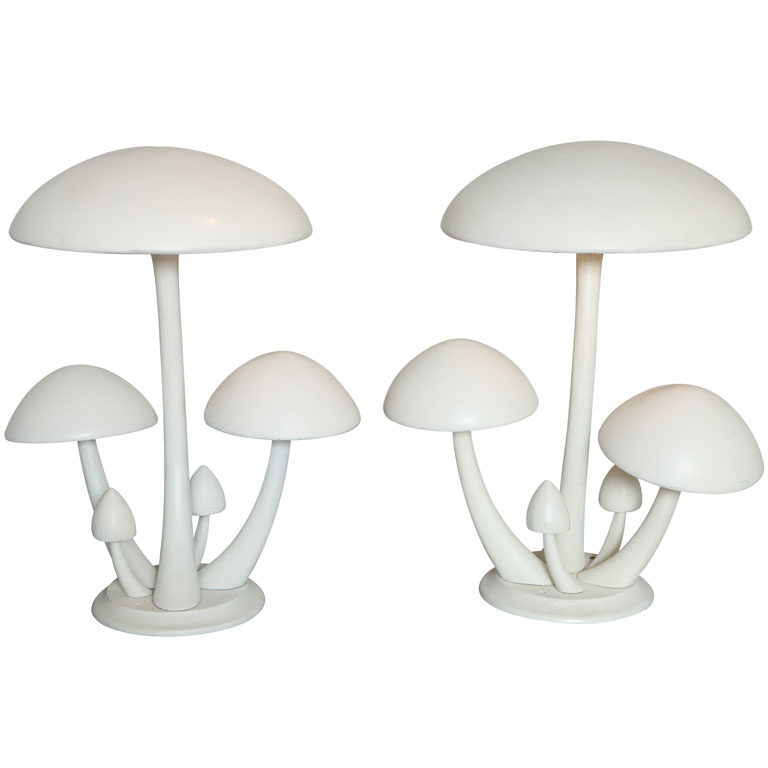
Pair of vintage Laurel Lamps from Maurice Beane Art & Design in Richmond, Virginia
Maze and Vale's Gathering fabric looks like a collection of spores
or dissections of mushroom gills.
Seen here in mustard... it's a wonderful match to the Laurel lamps.
Filaments of New York specializes in restoring and selling Art Deco and Mid-Century light fixtures.  And it’s a great place to indulge any mushroom cravings.
A Murano glass mushroom light,
two Italian, etched glass table lamps,
a pair of traditional student lamps
and these absolutely exquisite ceramic lamps... all from Filaments of New York.
You can visit them in Greenwich Village or online to seek guidance and shop for fabulous and surprisingly affordable lamps.

Keep in mind that fungi-inspired décor can avoid the kitschy or quaint.

Elizabeth Lyons Glass Mushrooms

Chanterelle ceramic vase from Janus et Cie
Iconic Chanterelle glass vase was designed by Tapio Wirkkala for Finnish lifestyle company Iittala.
I adore these Shady Side Candlesticks by Lindsey Adelman.

Detail of Shady Side Candlesticks
Stunning, early-20th century mushroom vase by Swedish ceramicist Wilhelm Kage.
Originally trained in decorative painting,
Wilhelm served as creative director of the prominent Gustavsberg Porcelain Factory
from 1917 until 1949, and influenced generations of Scandinavian potters and designers.
This vase is available for sale at the Jason Jacques Gallery in New York.
But I have to admit that, when it comes to toadstools, as in most things, I’m usually attracted to the quirky;

Pair of cement, fungi-forest lamps from Harris Kratz Antiques
pretty;

Benjamin Moore's Mushroom Cap (177)
animated;

Shroompers' Morella,
Rinus
and Rosepe are the sweetest wool felt dolls, only 2-3" tall,
brought to life by Canadian artists Charlotte Kolff and Damon Langlois.
and splendidly lush.

Instead of creating realistic, botanical guides, Art Nouveau artists, like Maurice Pillard Verneuil,
looked to nature for ornamental patterns: sinuous, sumptuously-colored and imaginative patterns.
These specific plates from his 1897 L'Animal dans la Decoration pattern book
(Lucans et Champignons, above, and Oiseaux, below)
are in the permanent collection of the New York Public Library.
But you can purchase originals of your own from Grey Heron Prints in Georgia.
Walter’s favorite mushrooms are Meiji's Chocorooms… those bite-size crispy, cracker-like cookies covered in milk chocolate.
The Japanese confectioner makes similar sweets in chopsticks and tiny Christmas-tree cones, but Walter swears they just don’t taste as good.  There’s something about that mushroom shape, like an elfin umbrella or pixie parasol, that makes all the difference.

So munch on Chocorooms.  One at a time, please.  And add a few mushrooms to your home décor for a little fun, and lots of luck, in 2013.