Showing posts with label winter. Show all posts

Saturday, March 2, 2013

Yuletide Plantings, Part 2

The legend of the Christmas Rose tells the story of a young shepherdess who wanted to bring a gift to the newly-born Christ Child.  Too poor to afford something grand and luxurious and unable to find even the simplest flower blooming in the dead of winter, she began to weep.  An angel witnessed her distress and took pity.  Miraculously, a plant emerged where her tears touched the ground, and she was able to present its beautiful white flowers to the Baby Jesus.

Of course, the Christmas Rose represents renewed hope, the triumph of grace and mercy over sin and death, and the purity of Jesus and Mary themselves.  Think of the German hymn, Es Ist ein Ros Entsprungen, or its English rendition, Lo, How a Rose E'er Blooming, which is usually sung between Christmas Eve and the Epiphany.

In Victorian and modern decorations, the Christmas Rose is often depicted as an almost perfect Tea blossom, sometimes pristine white, sometimes rosy pink, but the plant of lore was most likely Helleborus niger – an evergreen perennial, native to Central Europe and part of the Buttercup family.  Cultivated since ancient times and cherished in the Middle Ages and Renaissance, the flowers of Helleborus niger do look like native European species of the Rose.
Two Dog Roses on a Stem and a Lackey Moth Caterpillar
French watercolor, c. 1575, by Jacques Le Moyne de Morgues
from the permanent collection of the Victoria and Albert Museum.
However, I’ve never seen any Hellebore bloom at Christmas, at least not around here.  They usually refresh themselves about a month later… sprouting new growth and unfurling their faces, shiny white with lots of yellow stamens, and tinges of pink or acid green, that blush as they age.  I can see why they are often linked with St. Agnes of Rome, as a symbol of innocence and renewal, and in celebration of her Feast Day on January 21.

And let’s face it.  Anything that flowers in the middle of winter is a miracle!

We are lucky to have Pine Knot Farms, one of the premiere growers and breeders of Hellebores, right here in Virginia, and they offer several cultivars of the Christmas Rose and great guidance for growing all species of Helleborus.
The star-like Helleborus niger 'Double Fantasy',
Hellebores have gained popularity in recent years for their relatively-easy care, deer-resistant foliage and drought tolerance.  In general, they are happiest in well-drained soil and partial shade in Zones 4-9.  The most spectacular tend to be interspecies hybrids.
H. x ballardiae 'Cinnamon Snow',
 
H. x hybridus 'Peppermint Ice' and

H. x hybridus 'Shirley's Snow Stars' are all grown at Pine Knot Farms.
Pine Knot Farms is hosting the second half of their annual open house, today and Sunday.  But they also attend plant sales and festivals throughout the Mid-Atlantic, so don’t worry if you can’t make it to Southside Virginia this weekend.

I love cranberries and can eat them any time in any place.  But that bright, tart flavor, often combined with lots of sugar, nuts and a touch of orange or lemon, is most associated with Thanksgiving and Christmas, when the cranberry harvest is coming to an end.

The Cranberry is a low, creeping shrub in the Ericaceae or Heath family and grows naturally in cool, acidic marshes throughout the Northern Hemisphere.  It’s my understanding that all true Cranberries, including Vaccinium oxycoccos (Small Cranberry), native to the northern reaches of the continent and as far south as Idaho and Virginia, and Vaccinium erythrocarpum (Southern Mountain Cranberry), at home in the Southern Appalachians and looking much more like a Blueberry at about 5’ tall, with deciduous leaves and deep carmine berries, are indigenous to North America… although, some of these same species flourish in northern Europe and Asia.

The scientific nomenclature for Cranberry can get tricky.  For example, Vaccinium microcarpum, often called Bog or Small Cranberry, is sometimes listed as its own species, native to Europe, as well as, Alaska and Canada, but the USDA considers it synonymous with V. oxycoccos.  Cranberrry can be identified as subgenus Oxycoccus instead of genus Vaccinium.  So in reading and shopping, you may find the same V. oxycoccos described as Oxycoccus microcarpos or O. palustris.  And a plant like Vaccinium vitis-idaea L. ssp. minus, commonly known as Northern Mountain Cranberry, is actually an American subspecies of Ligonberry, native to New England, the Upper Midwest and Canada.  Close, but not really a Cranberry.  And more than a tad confusing.
Vaccinium macrocarpon 'Stevens' from Edible Landscaping
Here’s what I think is important to know:
The Cranberry has been a vital part of the American diet and culture for millennia;
It thrives naturally in the aforementioned habitat, especially where glacial deposits have left layers of sand and peat;
Vaccinium macrocarpon, also known as Large or American Cranberry, is the most common species used for both commercial and decorative endeavors.  Native to the East Coast, from Quebec to North Carolina, through the Upper Midwest, and then along the Pacific Coast, V. macrocarpon is hardy in Zones 2-7, reaches about 1’ tall and can spread 1’-6’ wide.

And if you’re thinking you need to create a bog in your backyard… never fear.  You can grow Cranberries as an ornamental groundcover in your home landscape.  Pick a sunny spot (with afternoon protection if you live in Zones 6 and 7), amend the soil, much as you would for Blueberries, keep your Cranberries hydrated and enjoy.  Edible Landscaping, a local mail-order nursery with a national following, recommends growing them in hanging baskets or containers where you can better control the soil and moisture content.  I can easily envision a pair of beautiful pots, surrounded by Narcissus ‘Polar Ice’ and Summer Snowflake (Leucojum aestivum), overflowing with evergreen foliage, plus pinkish-white, elongated-bellflowers and, of course, the berries we know and love.
Wouldn't 'Stevens' be lovely in this lichen-green glazed planter from Campania International?

The delicate 'Polar Ice' Daffodil from Brent and Becky's Bulbs
By the way, cranberries for juice, canned sauce and jelly are harvested wet.  You know that iconic scene when the fields are flooded and the berries are corralled in what look like giant islands of red?  But whole Cranberries, like the ones we use for baking, are harvested dry, just as we would in our own gardens.  Well, maybe on a slightly larger scale!

Viburnum trilobum, also known as the American Cranberrybush or High Bush Cranberry, is another garden-worthy native that dons Christmas colors, almost year round.  Of course, it’s not a Cranberry at all.  But it is very pretty and provides four seasons of interest.
Viburnum trilobum 'Redwing', developed by Johnson's Nursery,
is one of the prettiest in bloom and
It blooms when in leaf – large, flat, milky lace umbels, not unlike certain Hydrangea, that appear in May and June.  Hardy in Zones 2-7 and preferring acidic, moist but well-drained soil, V. trilobum can serve as a cool backdrop for your sunny border or filtered shade garden.  Clusters of scarlet drupes (truly the color we think of as cranberry or cardinal red) mature in early autumn.
fruit.
They are seriously sour but can be made into jellies and jams or left on the shrub where they will linger through winter, eventually softening, darkening, as a lovely foil to maroon fall foliage and an attraction for local birds and wildlife.
All V. trilobum sport Maple-like leaves,
but 'Redwing' glows with new growth of bronzy red.
Once again, take note.  Viburnum trilobum is sometimes identified as Viburnum opulus L. var. americanum or Viburnum opulus ssp. trilobum but should not be confused with the European Viburnum opulus, also known as Cranberrybush or Guelder Rose, which has proven to be invasive in certain states.  Both species, the native and foreign, have varieties named ‘Compactum’.

Powdery mildew and Viburnum Leaf Beetle can be problems for V. trilobum, but otherwise it is an easy-going shrub.  It’s a good replacement for some of my roses.  But in a more suburban setting, I would love to create a small grove of High Bush Cranberries interplanted with Kalmia latifolia ‘Elf’ and ‘Peppermint’
Kalmia latifolia 'Peppermint' from Meadowbrook Nursery in North Carolina. 
and the Kurume Azalea ‘Christmas Cheer’,
Colesville Nursery in Ashland, VA, is both a wholesale grower and retail garden center.
They usually stock 'Christmas Cheer'.
with one or two Hydrangea quercifolia ‘Snowflake’ and H. paniculata ‘Fire and Ice’, for quick succession of spring-summer bloom and appeal throughout the year… all in Yuletide colors.
'Snowflake' is an Oakleaf Hydrangea, but the long blossoms almost look like those of H. paniculata.
Absolutely beautiful flowers, peeling bark and fall foliage if you have the space.
From Meadowbrook Nursery
However, Christmas is a lot more than green, red and white.  It is a season full of richly saturated pigments… sugar-dusted candy and gaudy holiday lights…, the warm, comforting hues of oranges and spice cake, and pale shades just on the cusp of another like shimmering champagne and frosted moonlight.  Why not capture some of these colors, slightly burnished or silvered, fantastical and fun, in your own garden?

I can imagine sun-drenched steps flanked by
Delosperma cooperi ‘Lavender Ice’,
'Lavender Ice' and other varieties of Delosperma can be found at Bluestone Perennials.
Dianthus ‘Cranberry Ice’
'Cranberry Ice' is a favorite at Wayside Gardens.
and Veronica spicata ‘Icicle’;
'Icicle' also at Bluestone Perennials
a sheltered corner with
Hamamelis x intermedia ‘Gingerbread’,
Rare Find Nursery in Jackson, NJ, has an amazing selection of Witch Hazels,
including the slightly more petite 'Gingerbread'.
Callicarpa japonica ‘Snow Storm’,
'Snow Storm' and
Digitalis purpurea ‘Candy Mountain’
'Candy Mountain' are available at Bluestone Perennials.
Visit them in person or via the internet.
and Lilium ‘Star Gazer’ for bits of joyful color, from blossoms, berries and leaves, throughout the year;
or blanket a sunny bank with
Paeonia ‘Snow Clouds’,
'Snow Clouds' can be ordered through Viette Nurseries and
Caryopteris divaricata ‘Snow Fairy’
'Snow Fairy' is still in stock at Bluestone Perennials.
and Echinacea purpurea ‘Fragrant Angel’
If you can't find 'Fragrant Angel' at your local garden center,
check with White Flower Farm.
to mimic snowflakes and twinkling stars in the middle of sunshine-y, summer days.

And if your landscape is usually all green: Boxwood and Hosta, ornamental grasses and Pachysandra, then consider adding Hibiscus rosa-sinensis ‘Snow Queen’
A local grower usually brings 'Snow Queen' to our farmer's market...
at least once we're safely into May.  It's not usually hardy north of Zone 8.
Check with Mr. Jack's Farm in Charlotte, NC, if you can't find it in your town.
or Dahlia ‘Santa Claus’
Dahlia 'Santa Claus' is available through Burpee's catalog or website.
for flamboyantly festive blooms in late summer and fall when other gardens in the neighborhood have completely petered out.

Wednesday, February 20, 2013

Waiting for Spring: My Favorite Daffodils

So… I’m worried about my Daffodils.  I know there are many other, much more serious, problems that should consume my energy.  But right now, I’m really concerned about my Daffodils.

The problem is actually our erratic weather.  As I’ve mentioned before, Virginia’s climate is notoriously temperamental and diverse, and this winter is par for the course.  We started with rather cold temps in November followed by a dry, mild December.  That’s when my Daffodils started to peek out of the earth.  January was a roller coaster… some fluffy snow, torrential rains, a little ice interspersed with desiccating winds and stretches of frigid dryness.  February has been just as fickle.  25 degrees on Friday; 70 by the subsequent Wednesday, which means my Daffodils grow an inch one day and are zapped the next.  I watch and watch and wait.  It’s nerve racking, especially when Daffodils are usually the most light-hearted plants.
This was a forecast of rain.
Whether you call them Daffodils or Jonquils, these flowers are all varieties or cultivars of the species Narcissus, as in…
nar (the beginning of narcotic)
SIS (not your bro but your sis)

us (you and me).
Most folks run it all together, as in… nar-SIS-sus.
(In either case, the emphasis is on SIS.)
Originally from the middle of the ancient world: Europe, North Africa and western Asia,
Narcissus bulbs are incredibly adaptable and will thrive in any spot with well-drained soil, full-to-partial sun and 12-14 weeks of cool weather.  The chilly soil is important for root development.  There are some varieties that can handle the extended heat of Zones 9 and warmer.


‘Ice Follies’ is what I consider a perfect Daffodil.  I love its large, two-tone blossom with soft white petals, known as the perianth, and frilly, pale yellow cup.  The contrast is much more subtle than what is promised in most bulb catalogs: the trumpets emerge a light lemon, like the combination of sugar and egg yolks, and fade to an almost-alabaster that looks lit from within.
Last year's 'Ice Follies' and
Even in more regular years, ‘Ice Follies’ blooms early for me, usually by late-February, pushing through a bit of snow, and lasts through March.

‘Minnow’ is another favorite.  Like clusters of pert little faces, ‘Minnow’ blooms in the same color way, but slightly later, and its miniature coronae never diminish from that sunny yellow.
'Minnow' in my bulb bed.
You might have noticed a trend here.  I really prefer bicolor Daffodils, especially in combinations of white and yellow.  The eight by forty foot bank I call my “bulb bed” is planted with ‘Ice Follies’, ‘Minnow’ and ‘Fruit Cup’… a short, cheerful plant with more than one, open, almost-animated, bloom per stem, like a chorus standing at attention, and the distinct fragrance of canned fruit salad.  You know the one from childhood with heavy syrup and maraschino cherries.

The American Daffodil Society, horticulturists and bulb breeders classify Narcissus into thirteen divisions.

Cultivars or species are identified further by predominant color of perianth and corona.  So ‘Ice Follies’ is 2W-W (because the yellow cup fades to white) and ‘Fruit Cup’ is 7W-Y.  Dwarf Daffodils, like ‘Minnow’, can be confusing, because many catalogs and growers list them as a separate category.  But in fact, they share the same descriptors as “standard” Daffodils… just based on their baby blooms and often shorter stems.  I’m a big fan of miniature Daffodils.  They never flop over, even after heavy spring rains, and the ratio of foliage to flower just looks right to me.

Trumpet and Large Cup are the most common images of Daffodils: big blousy blossoms on tall, thin stems that sometimes reach hyperbole.  Each is like a crown for the royal frog prince, set askew.

Division 1 - Trumpet
One flower per stem; the corona or cup is as long as, or longer than, the perianth segments or petals.

The monochromatic ‘Dutch Master’, tall and brilliantly yellow, and ‘Mount Hood’, a faint lemon that matures to true-white, can hold their own in highway medians and urban parks.
I spotted these 'Dutch Master' among red Tulips and Cyclamen
over the weekend at Lewis Ginter Botanical Garden.
Currently, I don’t have any Trumpet Daffodils in my garden but I plan to add ‘Lorikeet’, slightly smaller than the aforementioned “big guns” with primrose petals and a salmon trumpet, and ‘Pink Silk’, even more petite with that elongated ballet-pink corona, under the arbor.
'Pink Silk' from Brent and Becky's Bulbs
Division 2 - Large Cup
Also, one flower per stem; the corona measures at least one-third the length (but is less than the full length) of the perianth segments.

Large Cup Daffodils are great for naturalizing and planting in large swaths.  ‘Ice Follies’ is part of the category, as is ‘Carlton’… conspicuously yellow with a bluish cast to the foliage.  A few ‘Carlton’ keep cropping up along our fence line where they were planted thirty or forty years ago.  If you love Large Cup, check out ‘Fortissimo’ for its giant blossom with oversized canary petals and frilly orange trumpet.
'Fortissimo' also from Brent and Becky's Bulbs
Division 3 - Short Cup
Tazetta, Poeticus and even some Cyclamineus Daffodils bear very small cups.  However a true Short Cup usually has only one flower per stem.  The corona measures less than one-third the length of the perianth segments.

‘Merlin’ and ‘Barrett Browning’ are two of my favorites.
'Merlin' and
Pretty ‘Jamestown’ suits the colors of bulb bank, but I’m afraid it might be overlooked in the mass planting.  Perhaps it would be best in small doses, brightening the blueberry bed.
'Jamestown' are usually available at Brent and Becky's Bulbs.
Division 4 - Double
There can be one or more flowers per stem.  Daffodils have a clustered cup, petals or both.  Sometimes the cup is ruffled but maintains a defined trumpet-shape.
I might just fall for 'Wave', also from Brent and Becky's Bulbs.
On other cultivars, the cup is almost hidden among the petals.  These very-layered blossoms can look like decoratively-iced cupcakes, or somewhat shaggy heads, where the petals mimic an explosion of tissue paper.

I have two cultivars: an anonymous hand-me-down with sulfurous petals threaded with strips of green (it is full scale) and ‘Rip Van Winkle’.  Popular since its introduction in the 1880s, dwarf and robust ‘Rip Van Winkle’ is often described as greenish-yellow.  But it blooms almost school-bus bright for me, with clustered flowers not unlike mini Chrysanthemum or Dahlia.  There are a lot of bicolor choices in Double Daffodils, including ‘Cheerfulness’, displaying creamy white petals with bits of straw around the feathery corona,
White Flower Farm usually offers a good selection of Double Daffodils,
including 'Cheerfulness' and
‘Ice King’, a sport of ‘Ice Follies’ with the same color combination and stamina, but a Carnation-like cup,
'Ice King'.
and tropical ‘Tahiti’, with layer upon layer of soft yellow petals and a little tuft of a trumpet with orange ruffles.
'Tahiti' can be ordered from Brent and Becky's or White Flower Farm.
Keep in mind... the colors are a lot softer in person!
Division 5 - Triandrus
Usually more than one flower per stem; these are the daffodils that resemble little bells or nodding heads.  Their petals are often narrow and curved and cups are short.

I’ve noticed that most in the division don very defined, slender petals, almost stellar in shape.  Triandrus is epitomized by the all-white ‘Thalia’.
'Thalia' from White Flower Farm
Considered an heirloom, because it was introduced before World War II, it is now available with a citrus trumpet as ‘Thalia Sun’.  Some folks who want happy, upright faces on their Daffodils dislike Triandrus’ droopy heads.  But I love that slightly old-fashioned, Snowdrop look.  They seem like falling stars.

Division 6 - Cyclamineus
One or two flowers per stem; petals are usually slender and significantly reflexed and paired with a straight and narrow corona.  Some exceptions exist, but these daffodils seem to have a perpetually wind-swept-look… not unlike a badminton birdie!

I have two different types of Cyclamineus: ‘Jack Snipe’, a combo of white and sunshine, and ‘Jetfire’, with deep gold petals and a faint orange trumpet, both tiny and rambunctious, growing among Hemerocallis ‘Hyperion’ and ‘Stella d’Oro’ and self-seeding Columbine.
'Jetfire'
But there is always room for more.  ‘Wisley’ is tempting for its white-and-yellow color way and terribly long trumpets.
'Wisley' from White Flower Farm
‘Beryl’ is the other extreme with shuttlecock petals and a thimble of a corona.  ‘Rapture’ is a lovely goldenrod selection.
'Beryl' from Brent and Becky's Bulbs
Jonquilla and Tazetta are perhaps the best performers for Southern gardens and forcing.  I personally like them because they provide so many flowers per bulb and come in a wide range of sizes and colors.

Division 7 - Jonquilla
There are usually one to three, very fragrant, blooms per stem.  These Daffodils have small “faces” with flat petals.  The foliage is narrow and onion-like.

‘Fruit Cup’ is a Jonquilla, as is the golden-mustard ‘Quail’ and this charming reverse bicolor called ‘Pipit’… all inhabitants of my backyard.
'Pipit' looks and smells lovely.
I also planted ‘Sun Disc’ many years ago, a shortie with two tones of yellow on a round Pansy face, but I can’t find them now.  They must have succumbed to disease or damp or more aggressive plantings.
'Sun Disc' from White Flower Farm; I'll have to consider planting them again.
Division 8 - Tazetta
Daffodils have clusters of florets, usually more than three but possibly as many as twenty, per stout stem.  Sweetly-scented, Tazetta sports short cups and petals that are slightly rounded and sometimes crinkled.  The foliage and stem are rather flat and broad.  Most Paperwhites are Division 8.

My favorite Tazetta include ‘Minnow’, of course, and ‘Geranium’, an older model that is reminiscent of the Poet’s Daffodil with shining, white petals and an orange-ish cup, the shade of butternut squash.
My 'Geranium' is in a sheltered spot, so the blossoms last a long time.
I’m anxious to see flirty ‘Falconet’, which I just planted around my cobalt blue fountain this past November.
My 'Falconet' came from Dutch Gardens.
Division 9 - Poeticus
Usually one flower per stem; these daffodils are known for their extremely white petals, which are sometimes “stained” with the color of the corona.  The cup is a small, crinkled disc, usually in shades of orange-red, with a green or yellow center.  Sometimes Poeticus is grouped with Small Cup or Tazetta in plant catalogs.
'Sea Green' from White Flower Farm
‘Sea Green’ perfectly showcases all the traits of Poeticus.  Also called Poet’s or Pheasant’s Eye Daffodils, these late-risers can extend your bloom time through May.

Division 10 - Bulbocodium Hybrids
Usually one flower per stem, the blossoms are really more trumpet than Daffodil.  They resemble tiny funnels or megaphones and are often described as “hoop petticoats”.

My itty bitty ‘Golden Bells’, a more floriferous hybrid of the species, always makes me smile.

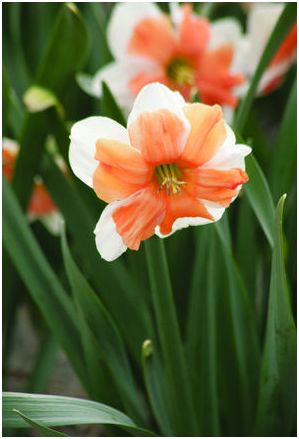
Division 11 - Split Corona
Once again, usually just one flower per stem.  Each Daffodil has a cup that is split more than half its length, almost as if you dissected the trumpet, crimped the edges, and pressed it flat among its petals.  Split Corona fall into two shapes: Collar and Papillon.  They may convey a similar frilliness as Double Daffodils, but the cup is much more evident and is often highlighted in a contrasting color to the petals.
'Electrus' from Brent and Becky's

'Cum Laude' from White Flower Farm
I’m not sure how I feel about these flamboyant Daffodils; they almost seem too decorative.  And I’ve yet to add any to the garden.

Division 12 - Other Cultivars
This is a catch-all for “bred” Daffodils that do not fit nicely into any other categories.  Most are hybrids between different divisional Daffodils.

Division 13 - Species
Another catch-all, but this time, for all the species and wild, or reputedly wild, varieties and hybrids.  These are Daffodils we only know by their botanical names.

Believe it or not, the ever popular Tete-a-Tete, hardly a misfit, as the most often-used Daffodil for commercial displays and forcing, is part of Division 12.  I planted additional Tete-a-Tete bulbs, late this autumn, skirting a pair of Abelia ‘Twist of Lime’.
Forced 'Tete-a-Tete'
But I’m thinking they may be a great way to fill in around the white-and-yellow blossoms in the bulb bed.  My friend, who works at a local nursery, told me I can spring plant bulbs that have been forced for containers and floral arrangements.  It would be handy to do it when the existing bulbs and perennials are emerging, so I can identify any empty spots.
'Tete-a-Tete' and 'Ice Follies'
Don't they look pretty together?
But first, I need to wait for the ground to thaw!  Definitely an anomaly in recent years, another batch of extreme cold is causing me, and my Daffodils, so much grief.  We’re more than ten degrees colder than the norm!

In truth, I know it’s not the end of the world.  Even if they don’t put on the greatest show this year, Daffodils are hardy fellows and, most likely, will rebound next year… and for generations to come.