Showing posts with label dessert recipes. Show all posts

Monday, December 17, 2012

Belated St. Lucy's Day: Norwegian Caramel-Almond Tosca Cake

Your December 13 may have been a lot like mine.  My thankfully uneventful work day included leftover Chinese for lunch, plus a trip to the fabric store, followed by a two-hour committee meeting.  It was 8 pm by the time I made it home for a little dinner and fretting over what still needed to be accomplished for the week.

Saint Lucy by Francisco de Zurbaran,
oil on canvas, c. 1625/1630
from the Chester Dale Collection at the National Gallery of Art
Hardly a day spent honoring St. Lucy or celebrating the triumph of light over darkness.

So, I decided to add tributes to St. Lucy to our weekend festivities… starting with Norwegian Caramel-Almond Tosca Cake for my boss’ holiday party.  Swedish Saffron Buns (Lussekatter) or Saffron Bread (Saffransbullar) are the more traditional Scandinavian treats for St. Lucy’s Day.  But this Tosca Cake is always a crowd pleaser.

The recipe comes from The Great Scandinavian Baking Book by Beatrice Ojakangas.
Cake:
3 eggs
1 cup sugar
1 teaspoon vanilla
1½ cups all-purpose flour
1½ teaspoons baking powder
¾ cup butter, melted
3 tablespoons milk

Topping:
1/3 cup butter
½ cup slivered blanched almonds
½ cup sugar
½ cup whipping cream
Beat the eggs until foamy.  Add sugar and beat until light and lemon colored; add vanilla.  Mix flour with baking powder and fold into the egg mixture until blended.
Mix the melted butter and milk and stir into the flour and egg mixture until batter is smooth and blended.  Turn into a buttered 10” springform pan or an 11” or 12” tart pan with a removable bottom.  Bake at 350 degrees for 35 minutes.  Meanwhile, prepare the topping.  Melt butter in a 8” or 9” frying pan.  Add almonds, and stir over medium heat until almonds are toasted and golden.  Stir in the sugar and cream.  Turn heat to high and bring to a vigorous boil, stirring constantly.
Boil for 2½ minutes just until mixture begins to become slightly darker tan and thickens slightly.  Pour hot topping over cake and place under broiler until topping is bubbly and lightly browned.

I follow the recipe as written and use a springform pan.  Our medium frying pan bit the dust awhile ago, so I just use a saucepan to brown the almonds and boil the caramel.  It works well, because there is sometimes a little splatter.

Here are two tips:
Gather your ingredients, but delay cooking the caramel until you have about 18-20 minutes left on the cake.  You don’t want it to harden or darken too much.
Once you have broiled the topping, allow the cake to cool on a wire rack for 15-20 minutes.  Then release the cake from the springform pan.
I know it sounds time-consuming to cook the cake three times: bake, boil and broil.  But you can tackle it all in about an hour.

No one has adequately explained to me why this cake has an operatic name, especially from such a violent opera.  But the sponge cake and crispy almond topping definitely seem like northern renditions of classic Italian flavors (with the addition of lots and lots of butter).  I’ve made the cake for birthdays and showers, but perhaps it is best suited for a celebration of Santa Lucia – the young Italian saint, whose story has been adopted and adapted and revered throughout Scandinavia, even now, more than a millennium after her death.

Sunday, August 26, 2012

End of Summer, Stone Fruits and Pound Cake

Whew!  The past nine days have been lovely.  Lovely because, despite several inches of rain and quite a bit of the usual humidity, our day and night temperatures have been surprisingly low for August.  Low enough to actually cook!  So after months of take-out and stovetop-only cooking, I’ve been baking: pumpkin bread, one batch with plums, another with blueberries; salmon with lemon and lots of pepper; and a delicious pound cake.

Pound cake in summer?  Most folks seem to prefer sponge or angel food cake, but I’m a fan of pound cake.  The perk of living in the southern end of the Mid-Atlantic is that we can grow a wide variety of fruit trees: apples, pears and cherries, of course, not to mention the wonderful stone fruits of late summer: peaches, nectarines and plums.  And it’s hard to improve on pound cake with sliced peaches or nectarines.  I could eat it for breakfast, lunch and dinner.
We're lucky enough to have 5 family orchards within 20 miles.
This is the closest; they offer pick-your-own peaches, nectarines and apples.
Or you can just buy already-picked fruits from their little market.
Plus they have great views to the Southeast...
the Southwest...
the Northwest...
and the Northeast.
The pretty weather also blew in some dramatic skies.
My favorite pound cake recipes come from the April 2000 issue of Cooking Light.  And perhaps the best of the bunch is Brown Sugar Pound Cake.  It reads as follows:

Cooking spray
3 tablespoons dry breadcrumbs
3 cups all-purpose flour
1 teaspoon baking powder
¼ teaspoon salt
¾ cup butter or stick margarine, softened
2 cups packed light brown sugar
1 tablespoon vanilla
3 large eggs
1 cup fat-free milk
1 tablespoon powdered sugar

Preheat oven to 350 degrees.

Coat a 10” tube pan with cooking spray, and dust with the breadcrumbs.

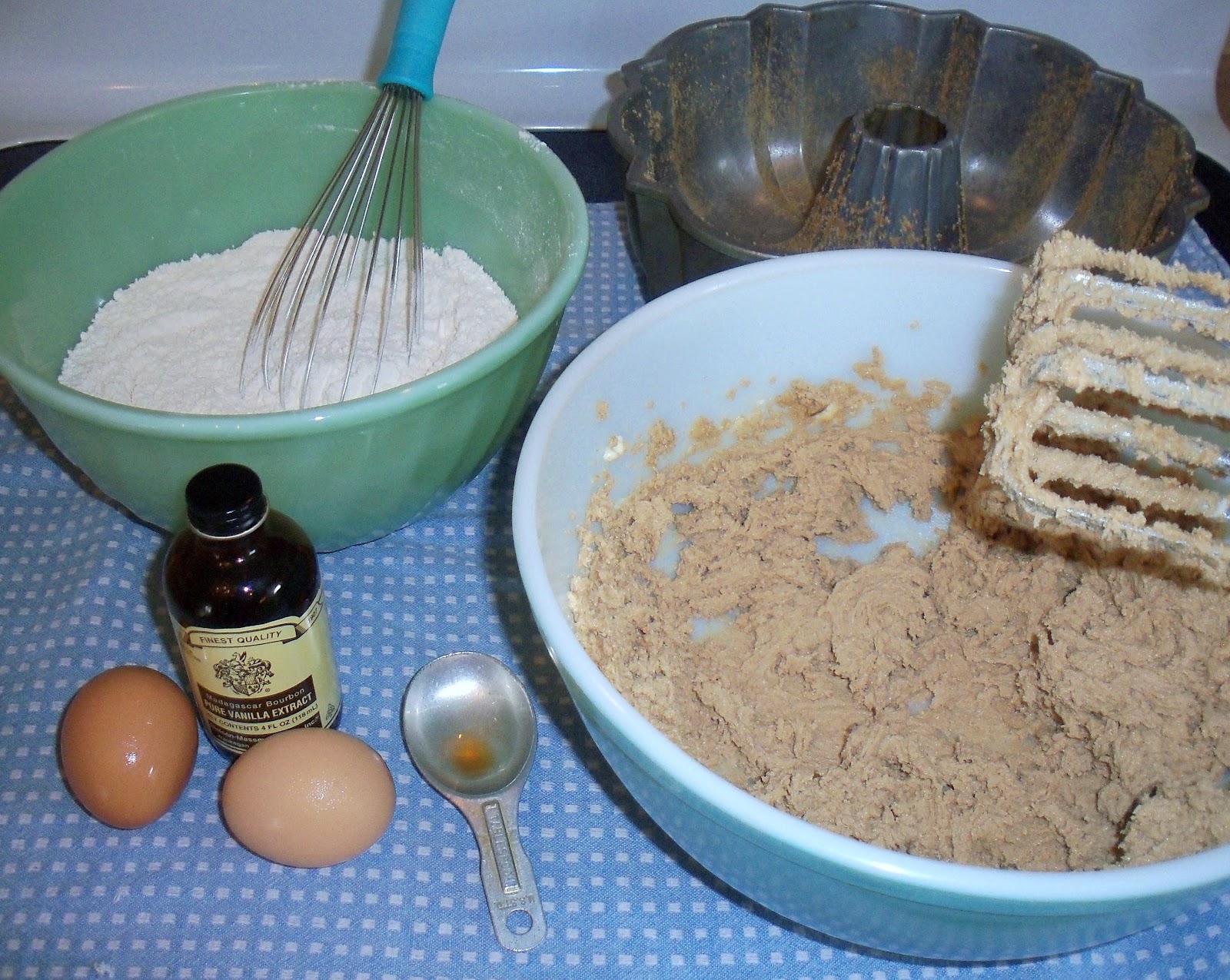
Lightly spoon the flour into dry measuring cups, and level with a knife.  Combine flour, baking powder, and salt in a bowl, stir well with a whisk.  Beat the butter in a large bowl at medium speed of a mixer until light and fluffy.  Gradually add brown sugar and vanilla, beating until well blended.  Add eggs, 1 at a time, beating well after each addition.  Add flour mixture to sugar mixture alternately with milk, beating at low speed, beginning and ending with the flour mixture.

Spoon the batter into prepared pan.  Bake at 350 degrees for 1 hour and 5 minutes or until a wooden pick inserted in the center comes out clean.  Cool in pan 10 minutes on a wire rack, and remove from pan.  Cool completely on a wire rack.  Sift powdered sugar over top of cake.
I basically follow the recipe as written, except
  • I use an old-fashioned 12-cup Bundt pan and reduce the oven temperature to 325 degrees.  The flutes of the Bundt make it really easy to cut small slices of cake.  Sometimes I can slice 24 for a party.
  • I grease the pan with butter.  To be honest, I’ve never gotten the hang of cooking sprays and just make a mess.  You can use graham, butter, or whole wheat cracker crumbs for your dry breadcrumbs.  This time I used the crumbs from the bottom of my box of Grape Nuts!
  • I don’t worry about fat-free milk.  I just use what’s on hand… this time – 2%.
The Black-and-White Pound Cake is also great and would be delicious served warm with peach ice cream and drizzled with a little chocolate syrup.  The recipe is similar.

Cooking spray
3 tablespoons dry breadcrumbs
3 cups all-purpose flour
1 teaspoon baking powder
¼ teaspoon salt
¾ cup butter or stick margarine, softened
2 cups granulated sugar
2 teaspoons vanilla
3 large eggs
1 cup 2% reduced-fat milk
¾ cup chocolate syrup
¼ teaspoon baking soda
1 tablespoon unsweetened cocoa

Preheat oven to 350 degrees.

Coat a 10” tube pan with cooking spray, and dust with the breadcrumbs.

Lightly spoon the flour into dry measuring cups, and level with a knife.  Combine flour, baking powder, and salt in a bowl, stir well with a whisk.  Beat the butter in a large bowl at medium speed of a mixer until light and fluffy.  Gradually add granulated sugar and vanilla, beating until well blended.  Add eggs, 1 at a time, beating well after each addition.  Add flour mixture to sugar mixture alternately with milk, beating at low speed, beginning and ending with the flour mixture.

Spoon two-thirds of the batter (about 4 cups) into prepared pan.  Add syrup and baking soda to remaining batter in bowl, stirring just until blended; spoon on top of batter in pan.

Bake at 350 degrees for 1 hour and 15 minutes or until cake pulls away from sides of pan.  Cool in pan 10 minutes on a wire rack; remove from pan.  Cool completely on a wire rack.  Sift cocoa over top of cake.

Pound cake is easy to freeze for later.  Once the cake has cooled, but before you have sprinkled it with powdered sugar or cocoa, slice up what you think you can’t eat in the next day or so.  Place slices in heavy-duty zip-lock plastic baggies.  Two slices will usually fit in a sandwich size.  Thaw by just bringing to room temperature.  Once thawed, you can also heat them up in the microwave for 15-20 seconds.
Brown Sugar Pound Cake with fresh sliced nectarines and a dollop of yogurt.
So take advantage of your local peaches and nectarines while you can.  Share them with pound cake and friends.  Yum!

Sunday, February 19, 2012

Coconut Swirls

Coconut is a popular symbol and flavor of Mardi Gras.  But sometimes a whole coconut cake is just too much sweetness… and a lot of work!  Coconut Swirls are like little bursts of coconut and chocolate and are a perfect Carnival dessert for all ages.  You just need a few ingredients and about an hour to “bake”.  This classic recipe was developed by Cheryl Newton in Florence, Alabama and shared with Southern Living readers many years ago.  It reads as follows:

1/3 cup butter or margarine
3 tablespoons water
1 teaspoon vanilla extract
2 cups sifted powdered sugar
½ cup instant nonfat dry milk powder
3 cups flaked coconut
1 cup (6 ounces) semisweet chocolate morsels


Melt butter in a medium saucepan over low heat.  Remove from heat, and stir in water and vanilla.

Combine powdered sugar and milk powder; stir ½ cup at a time into butter mixture until smooth.  Stir in coconut.  Shape into 1” balls, and place on ungreased baking sheets.  Chill 20 minutes.

Place chocolate morsels in a small heavy-duty zip-top plastic bag and seal.  Submerge in hot water until chocolate melts.  Snip a tiny hole in one corner of bag, and drizzle chocolate over coconut balls.  Store in refrigerator.

Yield: 3½ dozen

If you bake regularly, you probably have all these ingredients on hand, except the dry milk powder.  A couple hints:

Definitely sift your confectioner’s sugar.  You can even do it twice, so that there are no lumps when you add it to the melted butter.
The ultimate “batter” will be very sticky.  So keep a wet cloth or paper towel handy when you are rolling the balls.  Keep the balls small.  I always have difficulty making them consistent in size.  And don’t worry about crowding them on the cookie sheet.  They aren’t going to spread, and it just makes them easier to drizzle with chocolate.

I use miniature chocolate morsels.  They melt faster.  I’ve never had luck with the zip-lock baggie trick.  So I usually just make a pseudo-double boiler… this time, I set a metal bowl inside a pitcher of boiling water.  The chocolate melts in a minute.

And then I use a fork to kind of ribbon the chocolate over the balls.  It doesn’t have to be exact.  After all, it’s Mardi Gras!  But work as quickly as possible.  The chocolate will harden.
Yes, Coconut Swirls do taste very much like a Mounds candy bar with more emphasis on coconut.  Delicious and rather decadent.  Share with your friends and laissez les bon temps rouler!

Wednesday, February 1, 2012

Best Scones Ever

My scones are better than any other I've ever eaten.  I'm not bragging, because it really has nothing to do with me... and everything to do with the recipe.

It comes from this tiny cookbook by Leslie Weiner and Barbara Albright called Simply Scones: Quick and Easy Recipes for More Than 70 Delicious Scones and Spreads.  Quite a mouthful!  My rather battered and splattered edition is dated 1988, but I’ve only owned it since about 1994.  Scones are now readily available throughout the U.S., but things were very different twenty years ago.

Leslie and Barbara's recipes are adaptations of classic British scones.  Buttermilk Scones is the easiest, and in some ways, the most satisfying.  It reads as follows:

2 cups all-purpose flour
1/3 cup granulated sugar
1½ teaspoons baking powder
½ teaspoon baking soda
¼ teaspoon salt
6 tablespoons unsalted butter, chilled
½ cup buttermilk
1 large egg
1½ teaspoons vanilla extract
2/3 cup currants or raisins (optional)

Preheat oven to 400 degrees.

In a large bowl, stir together the flour, sugar, baking powder, baking soda and salt.  Cut the butter into ½” cubes and distribute them over the flour mixture.  With a pastry blender or 2 knives, used scissor fashion, cut in the butter until the mixture resembles coarse crumbs.  In a small bowl, stir together the buttermilk, egg and vanilla.  Add the buttermilk mixture to the flour mixture and stir to combine.  Stir in the currants, if desired.

With lightly floured hands, pat the dough into an 8”-diameter circle on an ungreased baking sheet.  With a serrated knife, cut into 8 wedges.  Bake for 18 to 20 minutes, or until the top is lightly browned and a cake tester or toothpick inserted into the center of a scone comes out clean.

Remove the baking sheet to a wire rack and cool for 5 minutes.

Using a spatula, transfer the scones to the wire rack to cool.  Recut into wedges, if necessary.  Serve warm, or cool completely and store in an airtight container.

Makes 8 scones

Simply Scones includes renditions of slightly less traditional scones.  And I have made the Apple Oatmeal, Bran, Brownie, Corn, Gingerbread, Cheese and Spiced Whole-Wheat ones with great success.  Today I baked a batch of Cran-Orange Scones:

½ cup chopped fresh or thawed frozen cranberries, drained
¼ cup plus 2 tablespoons granulated sugar
2 cups all-purpose flour
2 teaspoons baking powder
½ teaspoon salt
½ cup unsalted butter, chilled
2 large eggs
2 tablespoons orange juice
1 teaspoon vanilla extract
½ teaspoon grated orange peel
½ cup chopped pecans
1 egg white mixed with ½ teaspoon water for glaze (optional)

Preheat oven to 400 degrees.  Lightly butter a 10”-diameter circle in the center of a baking sheet.

In a small bowl, stir together the cranberries and 2 tablespoons of sugar.  Let stand about 5 minutes.

Meanwhile, in a large bowl, stir together the flour, remaining ¼ cup sugar, baking powder and salt.  Cut the butter into ½” cubes and distribute them over the flour mixture.  With a pastry blender or 2 knives, used scissor fashion, cut in the butter until the mixture resembles coarse crumbs.  In a small bowl, stir together the eggs, juice, vanilla and orange peel.  Add the egg mixture to the flour mixture and stir to combine.  The dough will be sticky.  With lightly floured hands, knead in the cranberry mixture and nuts until evenly distributed.  With lightly floured hands, pat the dough into a 9”-diameter circle on in the center of the prepared baking sheet.


Brush the egg white mixture over the top and sides of the dough, if desired.  With a serrated knife, cut into 8 wedges.  Bake for 20 to 25 minutes, or until the top is lightly browned and a cake tester or toothpick inserted into the center of a scone comes out clean.


Remove the baking sheet to a wire rack and cool for 5 minutes.

Using a spatula, transfer the scones to the wire rack to cool.  Recut into wedges, if necessary.  Serve warm, or cool completely and store in an airtight container.

Makes 8 scones

I eliminate the egg wash, because I don’t like the coating it always leaves on my teeth.  Plus it seems to affect the crumbly, buttery texture of the scone.  You can use walnuts or hazelnuts instead of pecans.

For some reason, these recipes read as if they are super complicated.  But believe me, with simple, yummy ingredients, you can whip up scones everyday for breakfast or an afternoon snack.  Just make sure your butter is chilled.  Don’t leave it sitting on the counter!  And a pastry blender or cutter helps create the coarse meal you want when adding the butter to your flour mixture.

Serve Buttermilk Scones with your favorite jam or preserves.  I personally like Mackays Scottish Three Berry Preserve.  (I haven’t made homemade preserves in years!)  No jam or cream needed with Cran-Orange Scones.  They taste like butter, fruit, jam and nuttiness all in one bite!

Monday, December 19, 2011

Eleanor's Cookies

This is the time of year when we anxiously await our gift of Christmas cookies from my friend Eleanor.
Eleanor is hands-down the best cookie baker I know.  She doesn’t have a huge or fancy kitchen, but she consistently creates the most delicious and perfect cookies.  So I’ve asked her to share some tips and the recipe for one of my favorites.  They are Cranberry Noels by Martha Stewart and the recipe is as follows:

1 cup (2 sticks) unsalted butter, room temperature
¾ cup sugar
2 tablespoons milk
1 teaspoon pure vanilla extract
2½ cups all-purpose flour
½ teaspoon salt
¾ cup dried cranberries
½ cup chopped pecans

In the bowl of an electric mixer fitted with the paddle attachment, cream the butter and sugar on medium speed until light and fluffy, about 2 minutes.  Add milk and vanilla.  Beat until just combined.  With mixer on low, gradually add flour, salt, cranberries, and pecans; continue beating until fully combined.

Turn dough out onto a clean work surface, and divide into 2 equal pieces.  Shape each piece into an 8” inch log, about 2” in diameter.  Wrap logs in plastic wrap, and refrigerate until firm, about 2 hours.

Preheat oven to 375 degrees.  Using a sharp knife, cut logs into 1/4” thick slices.  Transfer to parchment-lined baking sheets, about 1½” apart.  Bake until edges are golden, 14 to 16 minutes, rotating baking sheets halfway through.  Remove from oven, and transfer cookies to a wire rack to cool completely.

(Once formed into logs and wrapped well in plastic, the dough can be stored in the freezer for up to a month.  Before slicing, leave the dough at room temperature until it just begins to soften.  For a festive variation, roll the edges in colored sanding sugar before baking.)

Eleanor really likes this recipe, because it is basically a shortbread and does not require eggs.  That means there is one less ingredient to remember and the dough lasts longer.  So, it’s easy to prep and refrigerate while making other cookies.

Eleanor has a few recommendations for this recipe regarding…
The Dough
She says to completely incorporate the flour and salt before adding the nuts and cranberries.  And she always finishes mixing the dough by hand.  It helps ensure the nuts are evenly spaced.
It all starts with butter and sugar.
Make sure the flour and salt are blended in before...
Adding the nuts and fruit.
Making the Logs
Eleanor works the dough a little by hand, kind of compacting it, to eliminate any air pockets.  She works directly on plastic wrap.  The dough includes so much butter; it doesn’t stick.  Her logs are usually skinnier than 2”.  The diameter is the more important measurement… it’s okay if the logs are longer than 8”… that just means more cookies for everyone!
No flour needed to roll the log.
Cutting the Cookies
Since Eleanor often bakes in the evening on a limited schedule, she’ll usually refrigerate the dough overnight instead of just 2 hours.  She actually prefers the dough to be really cold and firm.  For this batch, she rolled the log in multi-colored sparkling sugar.  You can add the sugar before you chill, but then it tends to bleed into and discolor the dough.  Eleanor recommends sprinkling the log immediately after removing it from the refrigerator.  Lightly press the sugar into the dough.  A little colored sugar goes a long way.
Lightly press the sugar into the dough.
It doesn't look like a lot, but they are very sparkly when baked.
Eleanor gives her cookies as holiday gifts so she takes extra special care.  She will often measure the first couple cuts to make sure they are even.  And… since the log ends are crinkled from the plastic wrap, she usually pitches those little bits of dough.
Baking
Eleanor always bakes one sheet at a time and pivots the cookie sheet about mid-way through the baking time.  The most important thing is: make sure you re-refrigerate any remaining dough while your batches are baking.  You want your dough to stay firm!
Heading into the oven.
Just very lightly brown and almost ready to eat.
Fen thinks baking cookies is overrated and we should pay more attention to him!
In addition to Cranberry Noels, this year, Eleanor also gave us Lemon-Lime Refrigerator Cookies, Mexican Wedding Cookies, Lime Nut Buttons, Brownie Cookies with Cream Cheese, Thumbprints, Lemon Wreaths and Apricot Coconut Bars.  They are all incredibly yummy and absolutely beautiful.
Cookies can brighten any day.  Eleanor’s cookies are good enough to brighten a whole year.