So… I’m worried about my Daffodils. I know there are many other, much more
serious, problems that should consume my energy. But right now, I’m really concerned about my
Daffodils.
The problem is actually our erratic weather. As I’ve mentioned before, Virginia’s climate
is notoriously temperamental and diverse, and this winter is par for the
course. We started with rather cold
temps in November followed by a dry, mild December. That’s when my Daffodils started to peek out
of the earth. January was a roller
coaster… some fluffy snow, torrential rains, a little ice interspersed with
desiccating winds and stretches of frigid dryness. February has been just as fickle. 25 degrees on Friday; 70 by the subsequent
Wednesday, which means my Daffodils grow an inch one day and are zapped the
next. I watch and watch and wait. It’s nerve racking, especially when Daffodils
are usually the most light-hearted plants.
 |
| This was a forecast of rain. |
Whether you call them Daffodils or Jonquils, these flowers are all
varieties or cultivars of the species Narcissus, as in…
nar (the beginning of narcotic)
SIS (not your bro but your sis)
us (you and me).
Most folks run it all together, as in… nar-SIS-sus.
(In either case, the emphasis is on SIS.)
Originally from the middle of the ancient world: Europe, North Africa and
western Asia, Narcissus bulbs are incredibly
adaptable and will thrive in any spot with well-drained soil, full-to-partial
sun and 12-14 weeks of cool weather. The
chilly soil is important for root development. There are some varieties that can
handle the extended heat of Zones 9 and warmer.
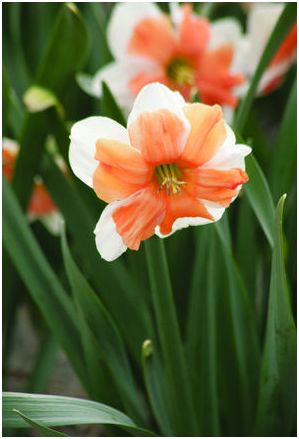
‘Ice Follies’ is what I consider a perfect Daffodil. I love its large, two-tone blossom with soft
white petals, known as the perianth, and frilly, pale yellow cup. The contrast is much more subtle than what is
promised in most bulb catalogs: the trumpets emerge a light lemon, like the
combination of sugar and egg yolks, and fade to an almost-alabaster that looks
lit from within.
 |
| Last year's 'Ice Follies' and |
Even in more regular years, ‘Ice Follies’ blooms early for me,
usually by late-February, pushing through a bit of snow, and lasts through
March.
‘Minnow’ is another favorite. Like clusters of pert little faces, ‘Minnow’
blooms in the same color way, but slightly later, and its miniature coronae
never diminish from that sunny yellow.
 |
| 'Minnow' in my bulb bed. |
You might have noticed a trend here. I really prefer bicolor Daffodils, especially
in combinations of white and yellow. The
eight by forty foot bank I call my “bulb bed” is planted with ‘Ice Follies’,
‘Minnow’ and ‘Fruit Cup’… a short, cheerful plant with more than one, open,
almost-animated, bloom per stem, like a chorus standing at attention, and the
distinct fragrance of canned fruit salad.
You know the one from childhood with heavy syrup and maraschino
cherries.
The American Daffodil Society, horticulturists and bulb breeders classify
Narcissus into thirteen divisions.
Cultivars or species are identified further by predominant color
of perianth and corona. So ‘Ice Follies’
is 2W-W (because the yellow cup fades to white) and ‘Fruit Cup’ is 7W-Y. Dwarf Daffodils, like ‘Minnow’, can be
confusing, because many catalogs and growers list them as a separate category. But in fact, they share the same descriptors
as “standard” Daffodils… just based on their baby blooms and often shorter stems. I’m a big fan of miniature Daffodils. They never flop over, even after heavy spring
rains, and the ratio of foliage to flower just looks right to me.
Trumpet
and Large Cup are the most common images of Daffodils: big blousy blossoms on
tall, thin stems that sometimes reach hyperbole. Each is like a crown for the royal frog
prince, set askew.
Division 1 - Trumpet
One flower per stem; the corona or cup is as long as, or longer
than, the perianth segments or petals.
The monochromatic ‘Dutch Master’, tall and brilliantly yellow, and
‘Mount Hood’, a faint lemon that matures to true-white, can hold their own in
highway medians and urban parks.
Currently,
I don’t have any Trumpet Daffodils in my garden but I plan to add ‘Lorikeet’,
slightly smaller than the aforementioned “big guns” with primrose petals and a
salmon trumpet, and ‘Pink Silk’, even more petite with that elongated
ballet-pink corona, under the arbor.
Division 2 - Large Cup
Also, one flower per stem; the corona measures at least one-third the
length (but is less than the full length) of the perianth segments.
Large Cup Daffodils are great for naturalizing and planting in
large swaths. ‘Ice Follies’ is part of
the category, as is ‘Carlton’… conspicuously yellow with a bluish cast to the
foliage. A few ‘Carlton’ keep cropping
up along our fence line where they were planted thirty or forty years ago. If you love Large Cup, check out ‘Fortissimo’ for its
giant blossom with oversized canary petals and frilly orange trumpet.
Division 3 - Short Cup
Tazetta, Poeticus and even some Cyclamineus Daffodils bear very
small cups. However a true Short Cup usually
has only one flower per stem. The corona
measures less than one-third the length of the perianth segments.
‘Merlin’ and ‘Barrett Browning’ are two of my favorites.
 |
| 'Merlin' and |
Pretty ‘Jamestown’ suits the colors of bulb
bank, but I’m afraid it might be overlooked in the mass planting. Perhaps it would be best in small doses,
brightening the blueberry bed.
Division 4 - Double
There can be one or more flowers per stem. Daffodils have a clustered cup, petals or
both. Sometimes the cup is ruffled but
maintains a defined trumpet-shape.
On
other cultivars, the cup is almost hidden among the petals. These very-layered blossoms can look like decoratively-iced
cupcakes, or somewhat shaggy heads, where the petals mimic an explosion of tissue
paper.
I have two cultivars: an anonymous hand-me-down with sulfurous
petals threaded with strips of green (it is full scale) and ‘Rip Van Winkle’. Popular since its introduction in the 1880s,
dwarf and robust ‘Rip Van Winkle’ is often described as greenish-yellow. But it blooms almost school-bus bright for me,
with clustered flowers not unlike mini Chrysanthemum or Dahlia. There are a lot of bicolor choices in Double
Daffodils, including ‘Cheerfulness’, displaying creamy white petals with
bits of straw around the feathery corona,
 |
White Flower Farm usually offers a good selection of Double Daffodils,
including 'Cheerfulness' and |
‘Ice King’,
a sport of ‘Ice Follies’ with the same color combination and stamina, but
a Carnation-like cup,
 |
| 'Ice King'. |
and tropical ‘Tahiti’, with layer upon layer of soft
yellow petals and a little tuft of a trumpet with
orange ruffles.
 |
'Tahiti' can be ordered from Brent and Becky's or White Flower Farm.
Keep in mind... the colors are a lot softer in person! |
Division 5 - Triandrus
Usually more than one flower per stem; these are the daffodils
that resemble little bells or nodding heads. Their petals are often narrow and curved and
cups are short.
I’ve noticed that most in the division don very defined, slender
petals, almost stellar in shape. Triandrus
is epitomized by the all-white ‘Thalia’.
Considered an heirloom, because it was
introduced before World War II, it is now available with a citrus trumpet as
‘Thalia Sun’. Some folks who want happy,
upright faces on their Daffodils dislike Triandrus’ droopy heads. But I love that slightly old-fashioned,
Snowdrop look. They seem like falling
stars.
Division 6 - Cyclamineus
One or two flowers per stem; petals are usually slender and significantly
reflexed and paired with a straight and narrow corona. Some exceptions exist, but these daffodils
seem to have a perpetually wind-swept-look… not unlike a badminton birdie!
I have two different types of Cyclamineus: ‘Jack Snipe’, a combo
of white and sunshine, and ‘Jetfire’, with deep gold petals and a faint orange
trumpet, both tiny and rambunctious, growing among Hemerocallis
‘Hyperion’ and ‘Stella d’Oro’ and self-seeding Columbine.
 |
| 'Jetfire' |
But there is always room for more. ‘Wisley’ is tempting for its white-and-yellow
color way and terribly long trumpets.
‘Beryl’ is the other extreme with shuttlecock
petals and a thimble of a corona. ‘Rapture’
is a lovely goldenrod selection.
Jonquilla and Tazetta are perhaps the best performers for Southern
gardens and forcing. I personally like
them because they provide so many flowers per bulb and come in a wide range of
sizes and colors.
Division 7 - Jonquilla
There are usually one to three, very fragrant, blooms per stem. These Daffodils have small “faces” with flat
petals. The foliage is narrow and onion-like.
‘Fruit Cup’ is a Jonquilla, as is the golden-mustard ‘Quail’ and
this charming reverse bicolor called ‘Pipit’… all inhabitants of my backyard.
 |
| 'Pipit' looks and smells lovely. |
I also planted ‘Sun Disc’ many years ago, a
shortie with two tones of yellow on a round Pansy face, but I can’t find them
now. They must have succumbed to disease
or damp or more aggressive plantings.
Division 8 - Tazetta
Daffodils have clusters of florets, usually more than three but
possibly as many as twenty, per stout stem. Sweetly-scented, Tazetta sports short cups and
petals that are slightly rounded and sometimes crinkled. The foliage and stem are rather flat and
broad. Most Paperwhites are Division 8.
My favorite Tazetta include ‘Minnow’, of course, and ‘Geranium’,
an older model that is reminiscent of the Poet’s Daffodil with shining, white
petals and an orange-ish cup, the shade of butternut squash.
 |
| My 'Geranium' is in a sheltered spot, so the blossoms last a long time. |
I’m anxious to see flirty ‘Falconet’, which I
just planted around my cobalt blue fountain this past November.
Division 9 - Poeticus
Usually one flower per stem; these daffodils are known for their extremely
white petals, which are sometimes “stained” with the color of the corona. The cup is a small, crinkled disc, usually in
shades of orange-red, with a green or yellow center. Sometimes Poeticus is grouped with Small Cup
or Tazetta in plant catalogs.
‘Sea Green’ perfectly showcases all the traits of Poeticus. Also called Poet’s or Pheasant’s Eye
Daffodils, these late-risers can extend your bloom time through May.
Division 10 - Bulbocodium Hybrids
Usually one flower per stem, the blossoms are really more trumpet
than Daffodil. They resemble tiny
funnels or megaphones and are often described as “hoop petticoats”.
My itty bitty ‘Golden Bells’, a more floriferous hybrid of the
species, always makes me smile.
Division 11 - Split Corona
Once again, usually just one flower per stem. Each Daffodil has a cup that is split more
than half its length, almost as if you dissected the trumpet, crimped the
edges, and pressed it flat among its petals.
Split Corona fall into two shapes: Collar and Papillon. They may convey a similar frilliness as
Double Daffodils, but the cup is much more evident and is often highlighted in
a contrasting color to the petals.
I’m not sure how I feel about these flamboyant Daffodils; they
almost seem too decorative. And I’ve yet to add any to the garden.
Division 12 - Other Cultivars
This is a catch-all for “bred” Daffodils that do not fit nicely into
any other categories. Most are hybrids
between different divisional Daffodils.
Division 13 - Species
Another catch-all, but this time, for all the species and wild, or
reputedly wild, varieties and hybrids.
These are Daffodils we only know by their botanical names.
Believe it or not, the ever popular Tete-a-Tete, hardly a misfit,
as the most often-used Daffodil for commercial displays and forcing, is part of
Division 12. I planted additional
Tete-a-Tete bulbs, late this autumn, skirting a pair of Abelia ‘Twist of
Lime’.
 |
| Forced 'Tete-a-Tete' |
But I’m thinking they may be a
great way to fill in around the white-and-yellow blossoms in the bulb bed. My friend, who works at a local nursery, told
me I can spring plant bulbs that have been forced for containers and floral
arrangements. It would be handy to do it
when the existing bulbs and perennials are emerging, so I can identify any
empty spots.
 |
'Tete-a-Tete' and 'Ice Follies'
Don't they look pretty together? |
But first, I need to wait for the ground to thaw! Definitely an anomaly in recent years, another
batch of extreme cold is causing me, and my Daffodils, so much grief. We’re more than ten degrees colder than the
norm!
In truth, I know it’s not the end of the world. Even if they don’t put on the greatest show
this year, Daffodils are hardy fellows and, most likely, will rebound next
year… and for generations to come.