Thursday, January 17, 2013

More Mushroom Musings


Packing up Christmas is a forlorn task – a chore that consumes more energy… physically and emotionally… than “decking the halls”.

Perhaps it’s the general malaise of January.  Our wintry skies appear gloomy and unnecessarily gray.  And it takes an enormous effort to reinstate a regular routine:
moderate culinary treats;
run household errands;
respond to belated emails and phone calls and mail.

While some folks struggle with the blues during that hectic stretch from Thanksgiving to New Year, it is usually the aftermath that makes me melancholy.  I miss the sparkle and mysticism and general busyness of the Christmas season.  I mean, when else is it completely acceptable to fill our homes with glitter, glitz, felt and wired ribbon?  Not to mention the emblems and characters of storybooks and folklore?
Mushrooms are popular for trimming the Christmas tree or dressing a traditional Buche de Noel (in meringue, of course).
 
Contact Mackenzie Limited, in Maryland,
if you're not up to baking, rolling and decorating your own yule log cake.
They also make delicious mushroom tarts... delivered right to your door.
Like so many of our Western customs, rituals and iconography involving mushrooms were adapted over centuries, from ancient, pagan ideas of winter and the supernatural, to conform with Christian beliefs and the development of national identities, until they became entrenched in our yuletide celebrations and cuisine… in the very concept of modern Christmas.  Legend attributes Santa’s ability to fly to Amanita muscaria, the fanciful, red and white, toadstool-shaped mushroom, which is indigenous to the pine forests of northern Europe and the pages of fairytales.
My funky little ornament and this trio of mushrooms come from Medusa Copenhagen in Denmark
and are designed by the mother-daughter team of Maj-Britt and Rie Bidstrup.
But in truth, mushrooms, especially edible ones, have long been recognized, throughout the world, as a gift of nature and a symbol of good luck, peace and prosperity.

So mushrooms seem like the perfect decorative start to 2013.
Caitlin Hilton just opened her Etsy store, Caites Plates, in December.
She paints her comical illustrations on simple, white porcelain.
For decorative use only, not food safe.
They add wit,
Shrooms Salt and Pepper by Jonathan Adler
warmth
The Mushroom Duvet Cover and Shams from West Elm and
Benjamin Moore's Morrel (AF-125) make for a cozy guest room.
and whimsy
Mushroom Pouf from Anthropologie
to our homes.  Plus, for the last two months, I’ve been obsessed with this charming print from Duralee’s Delfina Collection and am determined to use it somewhere soon!

Pattern 21025 is 95% cotton and comes in "Burlap" with mustard and blue accents,
"Aqua and Cocoa"
and "Moss" with red and burnt orange.
The repeat is about 12" vertically and horizontally.
Mushroom motifs are especially effective when the scale is a little out of whack.  The more miniature reinforces their enchanting, otherworldly qualities.
Pincushion from Foxtail Creek Studio
Terrarium accessories by Foxtail Creek Studio
Felt mushrooms fit for Thumbellina... by Feltville
And pastel ornaments for Christmas or Easter or any party favor, also by Feltville
The Maze and Vale Tiny Forest linen-cotton print shows how "little" can make a big impact.
Australian artist, Leslie Keating, screenprints her fabrics using natural dyes and fibers.
While the extraordinarily-large draws us into the story.

Mushroom Forest Coffee Table by California-based Thomas Wold.
Thomas crafts custom case goods and humorous furniture,
often pieced together from found objects and recycled shapes.
Mushroom Garden Stool from the Winterthur catalog
Trump Floor Lamp by Arteriors was recently featured in House Beautiful.
The image of the mushroom is recognizably commonplace and compellingly strange.  And the most appealing accessories somehow capture this dichotomy of mundane and magical.

Alberto Pinto's mushroom illustrations are beautiful,
but it's really the faux bois border that completes the fantasy.
Sous Bois Dinner Plate #4

Sous Bois Dinner Plate #5
Sous Bois Dinner Plate #6
The Fungi Lamp, by German designer Andreas Kowalewski, is constructed out of simple nylon webbing
and looks amazing when lit!

The juxtaposition of clean, white stoneware and cast pewter
is perfect on the Vegetable Dish by Vagabond House.
Joel Philip Myers served as Design Director at Blenko Glass through the 1960s,
and his creations, such as these decanters, combined function with fashion and fun.
Check out Culture Object for a stunning selection of Blenko and other Mid-Century glass.
Even these place card holders from Williams-Sonoma add a bit of enchantment to everyday life.
Use them to label food on a party buffet or book and magazine stacks in a personal library.
Lamps, particularly lamps of the 20th century, intrinsically mimic that familiar cap-and-stem shape… some more literally than others!
Cypriot Glass Lamp by Louis Comfort Tiffany and Clement Massier,
c. 1895-1910, blown and iridized glass, lustered ceramic base with bronze fittings,
from the permanent collection of The Corning Museum of Glass
Rattan Amanita Lamp, designed for Alessi, by brothers Humberto and Fernando Campana

Pair of vintage Laurel Lamps from Maurice Beane Art & Design in Richmond, Virginia
Maze and Vale's Gathering fabric looks like a collection of spores
or dissections of mushroom gills.
Seen here in mustard... it's a wonderful match to the Laurel lamps.
Filaments of New York specializes in restoring and selling Art Deco and Mid-Century light fixtures.  And it’s a great place to indulge any mushroom cravings.
A Murano glass mushroom light,
two Italian, etched glass table lamps,
a pair of traditional student lamps
and these absolutely exquisite ceramic lamps... all from Filaments of New York.
You can visit them in Greenwich Village or online to seek guidance and shop for fabulous and surprisingly affordable lamps.

Keep in mind that fungi-inspired décor can avoid the kitschy or quaint.

Elizabeth Lyons Glass Mushrooms

Chanterelle ceramic vase from Janus et Cie
Iconic Chanterelle glass vase was designed by Tapio Wirkkala for Finnish lifestyle company Iittala.
I adore these Shady Side Candlesticks by Lindsey Adelman.

Detail of Shady Side Candlesticks
Stunning, early-20th century mushroom vase by Swedish ceramicist Wilhelm Kage.
Originally trained in decorative painting,
Wilhelm served as creative director of the prominent Gustavsberg Porcelain Factory
from 1917 until 1949, and influenced generations of Scandinavian potters and designers.
This vase is available for sale at the Jason Jacques Gallery in New York.
But I have to admit that, when it comes to toadstools, as in most things, I’m usually attracted to the quirky;
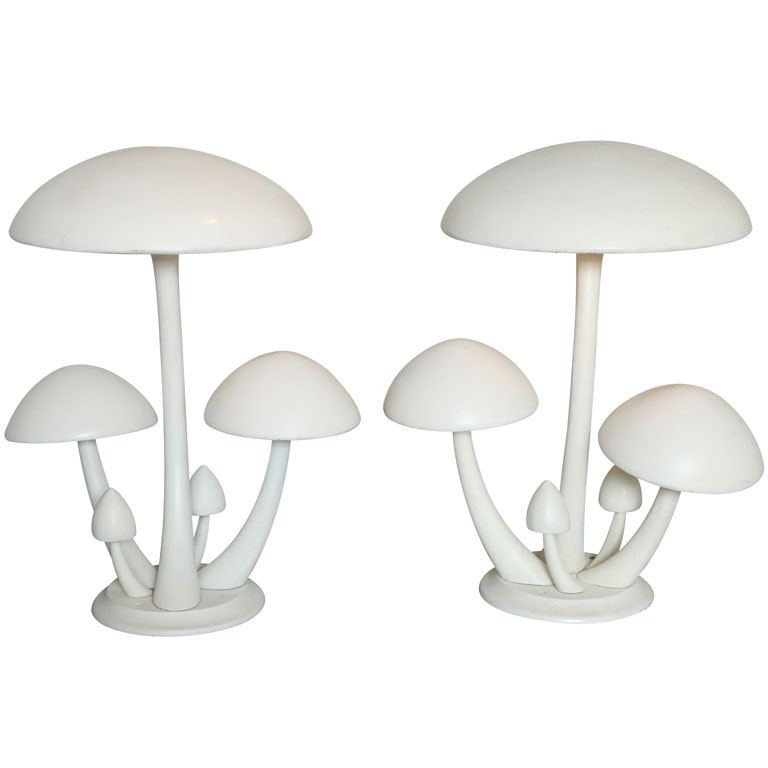
Pair of cement, fungi-forest lamps from Harris Kratz Antiques
pretty;

Benjamin Moore's Mushroom Cap (177)
animated;

Shroompers' Morella,
Rinus
and Rosepe are the sweetest wool felt dolls, only 2-3" tall,
brought to life by Canadian artists Charlotte Kolff and Damon Langlois.
and splendidly lush.

Instead of creating realistic, botanical guides, Art Nouveau artists, like Maurice Pillard Verneuil,
looked to nature for ornamental patterns: sinuous, sumptuously-colored and imaginative patterns.
These specific plates from his 1897 L'Animal dans la Decoration pattern book
(Lucans et Champignons, above, and Oiseaux, below)
are in the permanent collection of the New York Public Library.
But you can purchase originals of your own from Grey Heron Prints in Georgia.
Walter’s favorite mushrooms are Meiji's Chocorooms… those bite-size crispy, cracker-like cookies covered in milk chocolate.
The Japanese confectioner makes similar sweets in chopsticks and tiny Christmas-tree cones, but Walter swears they just don’t taste as good.  There’s something about that mushroom shape, like an elfin umbrella or pixie parasol, that makes all the difference.

So munch on Chocorooms.  One at a time, please.  And add a few mushrooms to your home décor for a little fun, and lots of luck, in 2013.

Wednesday, January 9, 2013

Trying to Stay a Little Healthy: Kale Chips

Potato chips are a food group unto themselves in our household.  Ridged, wavy, hand-cooked, kettle-cooked, Hawaiian, barbecue (usually known as bar-b-q) and fried with the skins on.  I especially love a combination of russet and blue potato with sweet potato chips.

But I’m trying… trying to limit my chip intake.  And I’ve discovered kale chips are a nice alternative.  First, they are actually roasted, not fried, so they are super easy to make at home.  Second, well, they are kale, which is packed with vitamins K, A and C plus iron, calcium, vitamin B6 and fiber – all the things I and, I suspect, you need this time of year.

I’ve never really excelled at cooking kale.  My mother often sautés it with tomato sauce and pepperoni, like her mother used to make, or parboiled potatoes.  But there is a real leatheriness to both of these dishes.  Kale chips, on the other hand, are like air… slightly nutty, crispy, almost-bitter air.  Plus they look gorgeously dark in a white or red bowl.  Somewhere between bottle green and obsidian black.

This recipe comes from Bon Appetit magazine and differs from other recipes I’ve read in its low cooking temperature.


12 large Tuscan kale leaves, rinsed, dried, cut lengthwise in half, center ribs and stems removed
1 tablespoon olive oil


Preheat oven to 250°F.  Toss kale with oil in large bowl.  Sprinkle with salt and pepper.  Arrange leaves in single layer on 2 large baking sheets.  Bake until crisp, about 30 minutes for flat leaves and up to 33 minutes for wrinkled leaves.  Transfer leaves to rack to cool.

I follow the recipe as written except I let the kale leaves break into their natural ruffles, so they are bite-size like actual chips.  I use one tablespoon of oil per 6 leaves of kale.  Also, I have no idea how to fit all that kale in one bowl, so I toss it in two batches.  I’m pretty generous with the salt and pepper.


Now, I must stress that kale chips are great alternatives to steamed or sautéed kale or deep-fried potatoes but in no way capture the lovely, greasy decadence that is eating a bag of potato chips!  So don’t try and fool anyone.  But snack to your heart's content.

Thursday, January 3, 2013

Yuletide Plantings, Part 1

The ‘Yuletide’ Camellias outside my office are brimming with buds, and I’m anxiously awaiting the initial bloom.  It’s not unlike receiving that first present at Christmas.  Sometimes the anticipation is just as great as the gift.
Monrovia grows 'Yuletide' for nurseries around the country.
Check with them for retailers in your neck of the woods.
And to be honest, these flowers are no sure thing.  Frigid overnight temperatures and a few days of ice and sleet could reduce each bud to tawny mush.  So I wait… in apprehensive hope.

Camellia sasanqua ‘Yuletide’ is my favorite camellia.  When in flower, its Christmas-red petals, surrounding a fat cluster of bright yellow stamens, remind me of Paeonia ‘Blaze’ or even the more exotic ‘Sword Dance’.
'Blaze' from Sandy's Plants in Mechanicsville, Virginia
 
'Sword Dance' from Viette Nurseries in Fishersville, Virginia
They are identifiably Japanese and yet seem right at home in Virginia’s urban gardens.  Their happy blooms are especially precious this time of year, set against an abundance of glossy, forest green leaves, miraculously delicate and tenacious, just at the start of real winter.
Camellia by Water, in style of Ogata Kenzan
hanging scroll, ink and color on paper, c.1741
from the H. O. Havemeyer Collection at the Metropolitan Museum of Art
We live at the western edge of the Piedmont, and Camellia’s range, and so there’s always a great deal of discussion about which is hardier: sasanqua or japonica.  I’ve heard votes for both.  Camellia sasanqua can handle a little more sun than japonica and tends to be more upright and slender.
The descriptors sasanqua and japonica can be confusing.
Camellia sasanqua originates from a small region in Japan,
while varieties of japonica grow naturally in many parts of Asia.
‘Yuletide’ is particularly charming for its tidy, slightly pyramidal shape.  Some folks trim it into standard tree form and prune the bottom branches.  But the three examples at work have been allowed to grow naturally.  Now, decades old, they are almost 10’ tall but only half as round.  Quite spectacular, really.  And they got me thinking about other plants that could extend the Christmas season throughout the year.

‘Yuletide’ is petite enough for even the smallest garden and would do well in a sheltered spot either as foundation planting or in a small grove of other shade-loving ornamentals.  Too much sun and wind are its greatest enemies.  Use its rich ever-greenery as a backdrop.  Underplant with Muscari armeniacum ‘Christmas Pearl’, Muscari ‘Peppermint’
Check with Brent and Becky's Bulbs for a fresh batch of 'Peppermint' next fall.
and Liriope muscari ‘Christmas Tree’ for a blanket of strappy foliage and pale purple blooms at the very beginning and end of the growing year.
Several years ago, I noticed quaint Liriope 'Christmas Tree'
along the Woodland Walk at Lewis Ginter Botanical Garden.
It can be difficult to find, even online and in garden catalogs.
Sandy's Plants supplies nurseries throughout the Mid-Atlantic...
or you can just buy directly from her.
Add some mossy pots of Caladium for a bit of iciness in the middle of summer.  ‘White Christmas’,
‘Peppermint’
and ‘Cranberry Star’
Classic Caladiums, in Central Florida, is a wholesale grower and breeder of Caladium.
They supply garden centers and florists around the country, but you can buy directly from them.
Just know that they usually require a minimum purchase of 10-25 bulbs.
capture the colors of ribbon candy.

Clear white and true red are difficult to breed in Daylilies; but there really isn’t a more cheerful color combination.  Can you imagine Hemerocallis ‘Christmas Wishes’ along a white picket fence?
'Christmas Wishes' from Oakes Daylilies in eastern Tennessee
Plant a swath of ‘Christmas Carol’,
'Christmas Carol' from Bluestone Perennials
‘Arctic Snow’
'Arctic Snow' from Roycroft Daylily Nursery where they only grow Daylilies...
just south of Georgetown, South Carolina
and ‘Carolina Cranberry’
'Carolina Cranberry' is also grown at Oakes.
Oakes, Roycroft and Viette's are all multi-generational, family-run businesses.
in front of Muhlenbergia capillaris ‘White Cloud’.
'White Cloud', at the United States Botanic Garden, was still a showstopper in mid-December. 
Interplant the Daylilies with Tulipa ‘Peppermint Stick’.
From Brent and Becky's Bulbs, near the Chesapeake Bay in Virginia
They all enjoy lots of sun and can handle a little drought.  Plus new growth on the Daylilies will hide Tulip foliage as it dies back.  Don’t worry… it is more subtle than it sounds.  Each species would have its moment, and if planted here in Virginia, the border would provide interest from April until December.

Hosta x ‘Christmas Tree’ and little ‘Ice Follies’ look like they have been edged in frosting.
'Christmas Tree' from Sandy's Plants
 
'Ice Follies' from Plant Delights
While each leaf of ‘Night Before Christmas’ and its sport ‘Christmas Candy’ seems filled with cream cheese or lemon custard.
'Night Before Christmas' from Sandy's Plants
 
'Christmas Candy' from Plant Delights
But Hosta ‘Stargazer’, a new introduction from Plant Delights in Raleigh, North Carolina, is perhaps the prettiest.
What a cool, sugary respite for your summer shade garden.

Varieties of Heuchera have been inspired by so many Christmas flavors, including the almost-indestructible Heuchera x brizoides ‘Plum Pudding’,
Check out Bluestone Perennials, based near the southern shore of Lake Erie, for a good selection of Heuchera.
marbled x americana ‘Peppermint Spice’,
From Sandy's Plants
villosa ‘Caramel’ with hints of peach and bronze and green,
You can order 'Caramel' for spring planting from White Flower Farm.
deeply-lobed ‘Chocolate Ruffles’,
and unusual ‘Mocha’ and ‘Ginger Ale’.
'Mocha' actually emerges in copper and then darkens to almost black.
The Missouri Botanical Garden has a lovely display of Heuchera, including 'Chocolate Ruffles' and 'Mocha'.
But Heuchera sanguinea ‘Snow Angel’ is my absolute favorite for its frilly leaves, speckled in grass green and ivory, and wispy rose-pink “coral bells”.
'Ginger Ale' and 'Snow Angel' are both available from Bluestone Perennials.
Polystichum acrostichoides is commonly known as Christmas Fern, probably because it remains green even in winter.  I’ve also seen gardeners include its slightly-olive fronds, sometimes dotted with brown sori, in wreaths and garlands.  Native to most of the eastern United States, leathery Christmas Fern lacks the lushness and rambunctiousness of other ferns.  But its mild temperament makes it a great addition to small gardens.  Waterlogged roots seem to be its main enemy.  Otherwise, Christmas Fern thrives in moist, well-drained or dry shade, even on rocky or wooded slopes, often snatching a spot beneath trees and large shrubs where little else will grow.
These Christmas Ferns were snapped at the Missouri Botanical Garden.
But I purchased mine through Monticello, where they are grown "in-house",
at the Thomas Jefferson Center for Historic Plants.
Gaultheria procumbens or Wintergreen is another “Christmas” plant native to the acidic forests of eastern North America.  Usually found among the groundcovers at nurseries and in plant catalogs, Wintergreen is a minute shrub that will eventually reach 6-8” tall and 2-3’ around.  I absolutely love Wintergreen for its sturdy, thumbprint leaves, in shades from bottle green to bronze, pinkish-white tinkerbell flowers throughout the summer and red, red fruits, like souped-up cranberries, in the fall and winter.
Wayside Gardens stocks Wintergreen year after year, but don't wait too long...
This all-around-great plant always sells out quickly in our area, so don’t hesitate if you find a healthy example at your local garden center.  Gaultheria procumbens enjoys partial shade but needs a little sun, preferably in the morning, to bloom best.  And yes, oil extracted from its glossy foliage is the original source of wintergreen flavoring!

For an interesting tapestry of foliage, plant a corner of bright shade with Christmas Fern, Wintergreen and Tiarella 'Sugar and Spice' and stay tuned for more yuletide plantings!